
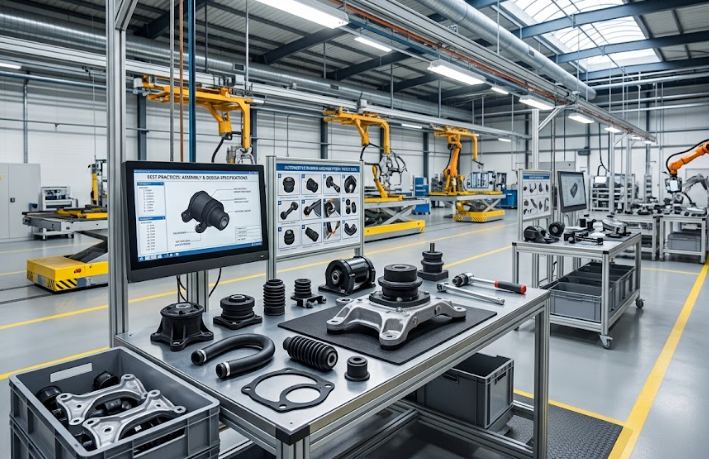
When assembling rubber products for demanding automotive sub-assemblies, precision engineering and material consistency are paramount to long-term vehicle reliability.
In modern automotive applications, elastomeric components such as engine bay grommets, suspension bushings, body weather seals, and powertrain gaskets act as critical barriers against environmental ingress, fluid leakage, and mechanical vibration.
However, improper assembly execution or suboptimal part design can lead to seal pinching, permanent deformation, or premature bond failure under severe thermal and mechanical stresses.
Banshu Rubber Indonesia operates as a trusted, fully integrated OEM manufacturing partner, combining certified IATF 16949 quality management with over 20 years of expertise in precision rubber compounding, molding, and sub-assembly manufacturing.
By supporting North American automotive engineering and procurement teams from early 3D CAD model evaluations through full-scale production, Banshu Rubber Indonesia ensures that complex elastomeric designs translate seamlessly into reliable, high-performance automotive assemblies.
Technical Fundamentals of Assembling Rubber Products in Automotive Engineering
Understanding the physical behavior of synthetic elastomers during mechanical joining is essential for establishing reliable production processes.
Unlike rigid metallic or thermoplastic parts that conform strictly to linear elastic mechanics, elastomeric materials display non-linear viscoelastic behavior under load, exhibiting time-dependent dynamic deformation during installation.
Elastomer Deformation Dynamics and Stress Relaxation
When an elastomeric component is inserted into a rigid mating housing, the rubber matrix experiences immediate tensorial strain, compressive stress, and local shear forces. Over time, the internal molecular chains realign, resulting in stress relaxation where the initial sealing force decays to a stable equilibrium state.
Automotive engineers must account for both stress relaxation and compression set, which is the permanent deformation remaining after compressive forces are released, to guarantee that static seals and dynamic dampening mounts maintain adequate contact pressure across thousands of thermal and mechanical duty cycles.
EPDM vs NBR Material Behavior Under Assembly Strain
Elastomer polymer selection directly dictates how components respond to mechanical stresses during EPDM and NBR rubber assembly:
1. EPDM (Ethylene Propylene Diene Monomer): Designed for extreme weatherability, ozone resistance, and elevated operating temperatures, EPDM is the primary polymer for under-hood coolant hoses, chassis isolators, and body weatherstrips. Under installation strain, EPDM offers high tensile elongation and resistance to tearing, making it resilient during aggressive automated press-fitting.
2. NBR (Nitrile Butadiene Rubber): Formulated specifically for hydrocarbon and fuel resistance, NBR is widely utilized in powertrain seals, fuel line dampers, and transmission gaskets. NBR exhibits higher baseline surface friction and lower ultimate elongation compared to EPDM, requiring exact mechanical lead-in chamfers and compatible lubricants during assembly to prevent surface lip tearing.
Impact of Shore A Hardness on Component Flexibility and Insertion Force
Durometer hardness, measured on the Shore A scale, directly influences both component flexibility and mating force during installation. Softer compounds (50 to 60 Shore A) conform readily to uneven mating surfaces and require lower installation force, but they are more susceptible to extrusion and pinching under high fluid pressures.
Conversely, harder compounds (70 to 80 Shore A) offer superior tear strength and resistance to mechanical deformation, but they demand significantly higher seating forces during automated assembly line operations.
Substrate Compatibility: Rubber-to-Metal and Rubber-to-Plastic Interfaces
Integrating flexible elastomeric seals with rigid metallic inserts (such as aluminum sub-frames or steel sleeves) or engineered thermoplastics (such as PA66-GF30) presents distinct mechanical challenges. Differences in the Coefficient of Thermal Expansion (CTE) between synthetic rubber and metallic substrates generate continuous interfacial shear stress during engine heat cycling. Furthermore, direct contact between conductive carbon-black-filled rubber compounds and lightweight aluminum components can induce galvanic corrosion unless proper insulating surface treatments or barrier coatings are applied.
Advanced Manufacturing Methodologies for Automotive Rubber Assembly
Achieving consistent quality across high-volume production requires advanced manufacturing techniques tailored to the functional demands of automotive rubber component assembly.
Vulcanized Chemical Bonding in Rubber-to-Metal Assemblies
For dynamic applications subjected to continuous shock, shear, and torsional loading, such as engine mounts, suspension control arm bushings, and torsional vibration dampers, a high-integrity rubber-to-metal bonding assembly is essential.
Hot vulcanized chemical bonding creates direct covalent cross-links between the elastomeric polymer chains and the metallic surface primer during elevated heat and pressure molding. Compared to cold secondary adhesive gluing, which degrades under engine bay heat and continuous dynamic vibration, hot vulcanization produces an interfacial chemical bond equal to or exceeding the cohesive structural strength of the rubber compound itself.
Surface Preparation Standards and Primer Application
Interfacial bonding reliability depends entirely on rigorous substrate pre-treatment. Banshu Rubber Indonesia enforces strict surface preparation protocols:
1. Substrate Degreasing and Cleaning: Metallic inserts undergo multi-stage aqueous chemical degreasing to eliminate residual machining oils and surface contaminants.
2. Mechanical Surface Profiling: Substrates are subjected to precision grit blasting to increase active surface area and create micro-mechanical keying.
3. Automated Primer Application: Heat-activated silane-based primers and bonding agents are applied with tightly controlled film thickness inside climate-controlled rooms, ensuring flawless chemical adhesion during subsequent overmolding or post-vulcanization processes.
Mechanical Assembly Techniques for Molded Rubber Parts
Non-bonded applications rely on interference fits, retention beads, snap-fits, and mechanical interlocks to secure rubber grommets, wiring harness covers, and protective boots into rigid panels without chemical adhesives.
Optimizing Insertion Force and Retention Strength Ratios
Designing interference joints requires balancing insertion force and assembly lubrication against required pull-out retention strength. Incorporating 15 to 30 degree lead-in chamfers, radiused sealing lips, and optimized wall-thickness transitions reduces peak installation force for assembly line operators or robotic arms, while maintaining high pull-out force to prevent accidental dislodgement caused by vehicle vibrations.
Assembly Lubrication Strategies: Temporary vs Permanent Lubricants
Assembly lubricants drastically reduce friction during installation, but improper selection can compromise component longevity:
1. Temporary Volatile Lubricants: Emulsified water-glycol or volatile synthetic fluids lower initial insertion friction during press-fitting and evaporate completely post-assembly, leaving a dry interface with high static friction that prevents post-installation movement.
2. Permanent Compatible Greases: Fluorosilicone or polyalphaolefin (PAO) greases are specified when long-term dynamic movement or repeated service disassembly is required. These formulations are strictly engineered to prevent polymer swelling, softening, or physical degradation in synthetic rubber matrices.
Design for Manufacturability (DFM) Guidelines for Automotive Rubber Parts
Applying practical DFM principles during early CAD modeling prevents costly mold modifications, reduces production cycle times, and eliminates assembly line defects. Submitting a CAD STEP technical drawing review to Banshu Rubber Indonesia enables our engineering team to evaluate part geometry and production feasibility prior to tooling fabrication.
Dimensional Tolerancing and ISO 3302-1 Standards
Because elastomeric polymers undergo volumetric thermal contraction during mold cooling, applying rigid metal machining tolerances to rubber drawings is unfeasible. Banshu Rubber Indonesia aligns manufacturing tolerances with ISO 3302-1 international standards:
1. Class M1 (High Precision): Specified for critical sealing rings, fuel system seals, and precision micro-molded connectors requiring minimal volumetric deviation.
2. Class M2 (Good Quality): The standard automotive commercial grade applied to engine grommets, suspension covers, and NVH dampening components.
3. Class M3 (Non-Critical): Applied to general protective covers and secondary dampening pads where wide dimensional latitude is acceptable.
Tolerance stack-up analyses must incorporate compound shrinkage rates and elastomeric recovery to ensure that maximum material conditions do not cause excessive assembly seating force.
Fixture Design and Automated Assembly Tooling
High-speed automated assembly lines require dedicated pneumatic press fixtures, positioning jigs, and specialized end-of-arm tooling (EOAT). Guided pneumatic actuators deliver controlled linear stroke speeds, preventing dynamic shock tearing of thin rubber sealing lips and ensuring complete 360 degree retention bead engagement.
Quality Assurance and Inspection Protocols for Rubber Assemblies
To ensure zero-defect deliveries to Tier-1 automotive sub-assembly lines, Banshu Rubber Indonesia maintains strict quality control and laboratory testing protocols under IATF 16949 certification.
Leak Testing, Destructive Pull Testing, and Vision Inspection
In-house quality verification combines non-destructive testing with destructive laboratory validation:
1. Pressurized Air Leak Testing: Every sealing grommet and fluid channel assembly undergoes automated pressure-decay leak testing to verify sealing integrity against micro-porosity and seating displacement.
2. Destructive Tensile Pull Testing: Bonded rubber-to-metal assemblies undergo calibrated hydraulic pull testing in our testing laboratory to measure interfacial bond strength, confirming 100% cohesive rubber failure rather than adhesive separation.
3. Automated Vision System Inspection: High-resolution optical vision systems inspect 100% of molded parts for parting-line flash extensions, surface voids, pinholes, and improper metal insert positioning before final packaging.
Partner with Banshu Rubber Indonesia for Precision Rubber Manufacturing
Banshu Rubber Indonesia is an established leader in custom rubber compounding, precision rubber mixing, and high-performance elastomeric component manufacturing for the global automotive and industrial sectors.
Backed by over 20 years of technical expertise and certified under IATF 16949 international quality standards, Banshu Rubber Indonesia operates advanced in-house rubber compounding facilities, automated molding equipment, and dedicated quality testing laboratories.
Our internal laboratory rigorously verifies all critical physical parameters, including Shore A hardness, tensile strength, elongation at break, and compression set resistance, ensuring every batch meets exact OEM specifications.
Whether you are developing complex engine bay seals, vibration dampening mounts, or high durability rubber-to-metal assemblies, our engineering team is ready to optimize your design for mass production.
Contact Banshu Rubber Indonesia today or upload your 3D CAD or STEP technical drawings and rubber material specifications to receive a comprehensive DFM evaluation and official RFQ within 24 hours.