
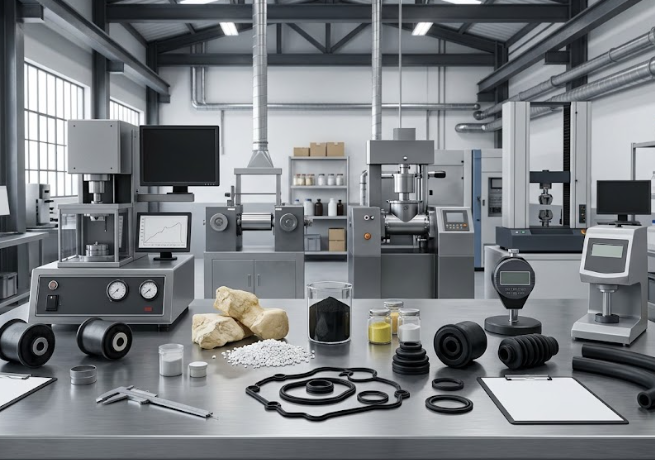
Custom rubber compound research serves as the critical technical foundation for original equipment manufacturers engineering next generation automotive and industrial components.
When standard off the shelf elastomeric materials fail under severe operational environments, custom polymer development becomes essential to guarantee part durability and fluid containment.
Banshu Rubber Indonesia operates as a trusted research and manufacturing partner, delivering certified IATF 16949 elastomeric compounding solutions to support North American engineering teams from initial concept to high volume serial production.
With over 20 years of manufacturing excellence in polymer chemistry and precision processing, Banshu Rubber Indonesia bridges the gap between material science and commercial scale production.
Our dedicated research laboratory enables materials specialists and OEM design leads to formulate tailored elastomer recipes that meet strict automotive callout standards. By integrating advanced chemical compounding, comprehensive testing, and structured technical consultation, we empower engineering teams to overcome complex material bottlenecks efficiently.
The Strategic Value of Custom Rubber Compound Research for OEM Engineering
Executing comprehensive custom rubber compound research provides original equipment manufacturers with a distinct technical advantage in product reliability and cost control. Generic off the shelf compounds often represent compromise formulations that degrade rapidly under non-standard operating conditions or unpredicted fluid exposure.
Investing in tailored OEM rubber compound development ensures that every mechanical property aligns directly with the functional demands of the target application.
In high-stakes automotive applications, relying on generic elastomeric formulations frequently leads to premature material hardening, unexpected warranty claims, and costly product recalls.
Custom compounding allows materials engineers to fine-tune specific performance parameters such as swell resistance, dynamic fatigue life, and thermal stability. This targeted engineering approach eliminates unnecessary material over-specification while guaranteeing uncompromising performance where it matters most.
Why Off-the-Shelf Elastomers Fail in High-Stress Operational Environments
Commercial off the shelf elastomers are typically formulated for generic, low-severity applications that do not reflect the harsh operating conditions of modern automotive engine bays or heavy industrial machinery. Under continuous exposure to elevated temperatures, aggressive synthetic fluids, and dynamic mechanical stresses, standard compounds suffer rapid chemical degradation.
This fundamental lack of material resilience leads to premature sealing failure and structural component breakdown.
Polymer Degradation Under Thermal, Chemical, and Dynamic Fatigue
Thermal exposure accelerates polymer chain scission and cross-link breakdown, causing standard elastomeric parts to become brittle and crack under operational strain. Simultaneous contact with synthetic lubricants, fuels, or cooling additives induces rapid volumetric swelling and polymer matrix softening.
Furthermore, continuous dynamic stress cycles generate internal heat buildup, accelerating mechanical fatigue and causing localized tear propagation across the component matrix.
Balancing Hardness, Tensile Strength, and Compression Set Resistance
Formulating high-performance elastomeric compounds requires balancing competing physical properties that naturally resist simultaneous optimization. Increasing Shore A durometer hardness to improve abrasion resistance often reduces ultimate elongation and increases flexural rigidity. Without precise chemical compounding, elevated hardness adversely affects compression set resistance, compromising the long-term elastic recovery necessary for fluid seals.
Custom Elastomer Selection and Polymer Architecture Strategy
Selecting the appropriate base polymer architecture represents the foundational step in custom elastomer compounding for specialized OEM requirements. Each synthetic rubber family offers distinct molecular characteristics that dictate its thermal boundaries, chemical resistance, and mechanical resilience. Our polymer chemists analyze operating parameters to select and modify the ideal base elastomer matrix for your application.
Tailoring EPDM, NBR, HNBR, and FKM Formulations for Specific OEM Callouts
We engineer specialized custom EPDM and NBR formulation recipes alongside high-performance specialty elastomers to satisfy demanding OEM engineering specifications. EPDM compounds are tailored with specialized curing agents to deliver exceptional resistance to ozone, ultraviolet radiation, and high-temperature steam in under-hood and body sealing applications.
For hydrocarbon and fuel contact, NBR and hydrogenated NBR (HNBR) are modified to optimize low-temperature flexibility alongside oil resistance, while fluoroelastomers (FKM) are deployed for extreme thermal and chemical environments up to 250 degrees Celsius.
The Custom Rubber Compound Research and Compounding Process at Banshu Rubber
At Banshu Rubber Indonesia, the custom rubber compound research and development process follows a disciplined, data-driven engineering methodology designed to transform technical specifications into validated material compounds. Our fully integrated research facility combines chemical modeling with physical laboratory verification to ensure total compound accuracy. Every step of our formulation workflow is documented and controlled under international quality management standards.
Chemical Formulation Engineering and Additive Optimization
Developing an optimal elastomer recipe involves the precise integration and balance of base polymers, reinforcing fillers, plasticizers, anti-degradants, and vulcanization chemistry. Our chemists adjust filler loading ratios using specific grades of carbon black or precipitated silica to achieve targeted tensile strength and modulus values.
Anti-ozonants and antioxidants are strategically introduced to neutralize environmental aging effects without disrupting curing kinetics.
Reinforcing Fillers and Cure System Selection
Selecting the correct vulcanization cure system is critical for controlling cross-link density and long-term elastic recovery in static and dynamic applications. Sulfur-cured systems provide high tensile strength and superior tear resistance, making them suitable for dynamic dampening components.
Alternatively, peroxide-cured systems establish highly stable carbon-carbon cross-links that deliver exceptional compression set resistance and elevated thermal stability for high-temperature fluid seals.
Mooney Viscosity and Moving Die Rheometer (MDR) Testing
Comprehensive rubber rheology testing is conducted on every laboratory formulation to analyze flow behavior, scorch safety, and vulcanization kinetics prior to production molding.
Utilizing advanced Moving Die Rheometers (MDR) and Mooney viscometers, our laboratory measures minimum torque, scorch time, and optimum cure time across varying temperature profiles. This precise rheological data ensures optimal mold flow during production while preventing premature scorch defects.
Material Matching for ASTM D2000 and SAE J200 Callouts
North American automotive and industrial engineering teams routinely specify material requirements using standardized ASTM D2000 and SAE J200 callout systems.
Our technical team specializes in decoding complex line callouts, translating alphanumeric specifications for durometer, tensile strength, heat resistance, and fluid immersion into exact compounding formulations. We ensure that every custom batch fully satisfies or exceeds the required grade suffix requirements specified in your engineering callout.
Scaling Custom Formulations from Lab Batches to Mass Production
Transitioning a successful laboratory formulation to full-scale commercial manufacturing requires rigorous process control to prevent material property shifts. Banshu Rubber Indonesia utilizes identical mixing technologies in both our development lab and full production line to guarantee seamless scalability. This consistency eliminates technical surprises and ensures that mass-produced components mirror the exact physical performance of initial prototype samples.
Precision Banbury Mixing and Batch-to-Batch Consistency
To maintain flawless material homogeneity across production runs, we utilize high-capacity internal Banbury mixers equipped with automated micro-ingredient dosing and computerized temperature control.
Controlled dispersion of carbon black, curative agents, and specialty additives eliminates localized hard spots and variable cure states within the rubber matrix. This automated mixing process guarantees that every production batch exhibits identical physical properties and processing characteristics.
Quality Assurance Protocols Under IATF 16949 Standards
Quality control is embedded into every stage of our manufacturing process through IATF 16949 rubber mixing management protocols. Every master batch undergoes mandatory laboratory verification for durometer hardness, specific gravity, and rheological cure curves before release to production molding lines. Certified Certificates of Analysis (CoA) accompany every shipment, providing complete material traceability and verification for incoming OEM inspection.
Accelerating OEM Product Development Through Engineering Consultation
Engaging in early engineering consultation for rubber compounding with our technical specialists significantly shortens overall product development timelines and reduces tooling risk.
Involving material engineers during the initial CAD design phase allows for simultaneous optimization of part geometry, mold flow, and material formulation. This collaborative engineering approach prevents costly redesigns and accelerates the path from prototype validation to serial market launch.Accelerate Your Material Innovation with Banshu Rubber Indonesia
Banshu Rubber Indonesia is an established leader in custom rubber compounding, precision polymer mixing, and high-performance elastomeric component manufacturing for the global automotive and industrial sectors.
Backed by over 20 years of technical expertise and certified under IATF 16949 international quality management standards, Banshu Rubber Indonesia operates advanced in-house rubber compounding facilities, automated internal Banbury mixing lines, and fully equipped testing laboratories.
Our internal testing laboratory rigorously verifies all critical physical parameters, including Shore A hardness, tensile strength, elongation at break, compression set resistance, and rheological cure kinetics according to ASTM D2000 and SAE J200 standards.
Whether you are developing complex engine bay seals, fuel system diaphragms, or custom dynamic dampening mounts, our engineering team is prepared to accelerate your product development lifecycle through specialized engineering consultation for rubber compounding.
Fill out our technical consultation form today and upload your 3D CAD or STEP technical drawings and material performance callouts to receive a comprehensive DFM evaluation and official RFQ within 24 hours.