
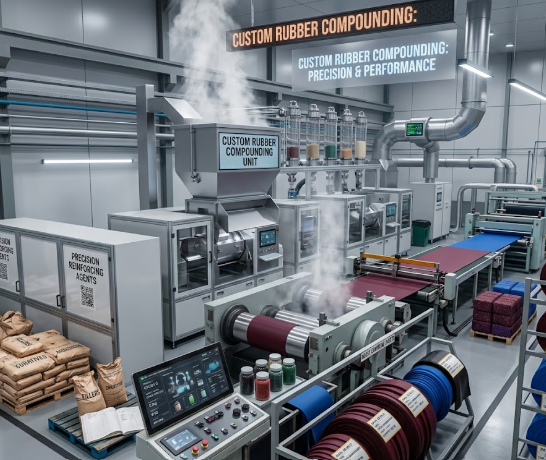
Rubber components often operate in conditions where a standard off the shelf material cannot provide the required combination of durability, chemical resistance, temperature stability, and mechanical performance. For OEMs and industrial manufacturers, selecting the right elastomer is therefore only the starting point.
The real performance of a rubber component is determined by how the polymer is formulated, processed, tested, and validated for its intended application. This is where custom rubber compounding becomes an important engineering discipline, allowing manufacturers to develop material properties around the actual operating requirements of the finished component.
A properly developed compound can improve component reliability while reducing premature failures, processing problems, and unnecessary material costs. For demanding applications, custom rubber compounds can also provide a controlled alternative when an existing material no longer meets current performance, regulatory, or supply chain requirements.
Understanding Custom Rubber Compounding
Custom rubber compounding is the process of developing a rubber formulation specifically for a defined application or performance requirement. Instead of selecting a commercially available compound based only on general material properties, engineers adjust the polymer system, fillers, curing system, plasticizers, processing aids, and protective additives to achieve a targeted performance profile.
The formulation must be considered as a complete system because changing one ingredient can affect several other properties. Increasing filler loading, for example, can influence hardness, tensile strength, modulus, viscosity, heat generation, and processing behavior at the same time.
For an OEM, this means the objective is not simply to create a harder or softer rubber. The objective is to establish the right balance between mechanical properties, environmental resistance, processability, durability, and cost for the specific component.
This approach is particularly valuable for seals, gaskets, bushings, mounts, hoses, vibration isolators, and other components that must maintain performance throughout a defined service life.
Why Custom Rubber Compounds Matter for OEM Applications
A rubber part can be exposed to several failure mechanisms simultaneously. Temperature cycling, oil exposure, water, ozone, compression, vibration, friction, and dynamic loading can interact with one another and accelerate material degradation.
A compound designed for one environment may therefore perform poorly in another. An elastomer that provides excellent weather resistance may not provide the required oil resistance, while a highly oil resistant material may require additional formulation work to achieve the desired low temperature flexibility.
Custom rubber compounds allow engineers to optimize these tradeoffs. Instead of treating material selection as a simple polymer comparison, rubber compound development considers the entire operating environment of the finished component.
The result can be a formulation that provides a more predictable processing window and a better relationship between material cost and component performance. For high volume OEM production, this optimization can have a significant effect on total manufacturing cost because material behavior directly influences molding cycle stability, scrap rates, and component durability.
Core Ingredients in Custom Rubber Compounds
Base Elastomers
The base elastomer provides the fundamental characteristics of the compound, but its final performance depends heavily on the formulation surrounding it. Common elastomers used in industrial applications include EPDM, NBR, natural rubber, silicone, neoprene, and FKM.
EPDM is widely used when resistance to weathering, ozone, water, steam, and elevated temperature is important. It is commonly considered for automotive weather seals and other outdoor or water exposed applications, but it generally does not provide the same oil resistance as NBR or FKM.
NBR is commonly selected for applications involving petroleum based oils and fuels. Its performance depends on the acrylonitrile content, which influences the balance between oil resistance and low temperature flexibility.
Natural rubber provides excellent elasticity, tensile strength, tear resistance, and dynamic fatigue performance. It can be particularly useful for vibration isolation and dynamically loaded components, although its resistance to ozone, weathering, and certain chemicals is more limited than some synthetic elastomers.
Silicone rubber offers a wide temperature operating range and strong resistance to weathering and aging. It is frequently considered for applications where temperature stability and environmental durability are more important than high abrasion or tear resistance.
Neoprene provides a useful balance of weathering, ozone, oil, and flame resistance. It can be appropriate for applications requiring a general purpose elastomer with a broader environmental resistance profile.
FKM is used when demanding resistance to high temperatures, fuels, oils, and aggressive chemicals is required. The material is typically more expensive than many general purpose elastomers, so its use should be justified by the actual operating environment.
The correct elastomer is therefore determined by application requirements rather than by material popularity. In practice, compound engineers often need to balance several properties instead of maximizing one property in isolation.
Functional Additives and Their Role
Fillers are among the most influential ingredients in a rubber formulation. Carbon black can improve reinforcement, tensile strength, abrasion resistance, hardness, and electrical properties, while silica can provide different reinforcement and dynamic performance characteristics depending on the formulation and coupling system.
Plasticizers and processing oils can modify viscosity, flexibility, processability, and low temperature behavior. Their selection must be compatible with the polymer and application because migration, extraction, volatility, and chemical exposure can influence long term performance.
Curing systems determine how the polymer chains form a crosslinked network. Sulfur based systems are widely used with many unsaturated elastomers, while peroxide curing can be selected when different heat resistance or compression performance is required.
Antioxidants and antiozonants protect the compound from degradation caused by oxygen, heat, ozone, and other environmental factors. Their selection and concentration must be carefully controlled because excessive or incompatible additives can affect processing and finished component performance.
The formulation process is therefore an exercise in balancing interactions. The compound engineer must understand not only what each ingredient does individually, but also how ingredients interact during mixing, curing, and long term service.
What Makes a Rubber Formulation Proprietary
Proprietary rubber formulations are formulations developed and controlled by a manufacturer for a specific application, customer, or performance requirement. The value of the formulation can come from the specific combination of materials, ingredient ratios, processing conditions, and accumulated development knowledge.
A proprietary formulation does not necessarily mean that every individual ingredient is unique. In many cases, the competitive advantage comes from how conventional raw materials are combined and processed to achieve a specific performance window.
This knowledge can represent significant intellectual property because developing a reliable compound can require extensive laboratory work, mixing trials, physical testing, rheological analysis, prototype evaluation, and production validation.
For this reason, formulation control and confidentiality are important considerations when OEMs work with a custom compounding partner. The commercial relationship should clearly define ownership, confidentiality, formulation access, change control, and approval requirements.
When Manufacturers Need Proprietary Rubber Formulations
One common reason for developing a proprietary formulation is a demanding operating environment. Components used around engines, transmissions, industrial equipment, hydraulic systems, or outdoor machinery may require a combination of chemical resistance, temperature stability, compression resistance, and mechanical durability that is difficult to achieve with a generic compound.
Another situation occurs when a legacy rubber material is discontinued or its original supply chain becomes unreliable. Rather than redesigning the entire component, an OEM may work with a compounder to develop a technically equivalent or improved replacement material.
Regulatory changes can also trigger compound redevelopment. Restrictions on specific substances, customer material specifications, environmental requirements, or regional compliance requirements may require manufacturers to modify an existing formulation while maintaining critical performance characteristics.
In these situations, rubber compound development becomes a material engineering project rather than simply a purchasing activity.
The Rubber Compound Development Process
Step 1: Requirements Gathering and Application Analysis
The development process begins with understanding what the rubber component must actually do. Engineers need to identify operating temperature, pressure, mechanical loading, chemical exposure, compression conditions, environmental exposure, expected service life, and manufacturing process.
The geometry and application of the component are also important. A static gasket, dynamic seal, engine mount, vibration isolator, and molded hose may require very different material characteristics even when they operate in similar temperature ranges.
The target specifications should therefore be established before laboratory formulation begins. This creates a technical framework for deciding which properties must be optimized and which compromises are acceptable.
Step 2: Laboratory Formulation and Mixing
Once the requirements are defined, compound engineers develop initial laboratory formulations. Small scale batches allow engineers to evaluate different polymer and additive combinations before committing to production quantities.
Laboratory mixing must replicate the critical mechanisms of production mixing as closely as practical. Polymer breakdown, filler incorporation, dispersion, temperature development, and curing ingredient addition all influence the behavior of the resulting compound.
Multiple formulation iterations may be necessary. The goal is not to find a formulation that performs well in only one laboratory test, but to establish a balanced formulation that can meet the complete performance specification.
Step 3: Testing and Material Qualification
The next stage is systematic material testing. Tensile strength and elongation can be evaluated using ASTM D412, while compression set can be evaluated using ASTM D395 under the applicable test conditions.
ASTM D2000 provides a standardized system for specifying and classifying vulcanized rubber materials based on properties such as hardness, tensile strength, and resistance to heat, oil, and other specified conditions. However, ASTM classifications should not replace application specific engineering requirements.
Rheological testing is also important because processing behavior can influence molding and extrusion performance. Cure time, scorch behavior, viscosity, and cure characteristics help engineers determine whether a compound is suitable for the intended manufacturing process.
Testing should include both initial properties and aging performance when long term durability is important. Heat aging, fluid immersion, ozone exposure, compression set, and other environmental tests can reveal degradation mechanisms that are not visible in initial physical testing.
Step 4: Prototyping and Field Validation
Laboratory results alone do not guarantee that a compound will perform correctly in the finished component. The material must be processed into representative parts so engineers can evaluate mold filling, surface quality, dimensional behavior, curing, and part performance.
Prototype testing provides an important connection between material formulation and component design. A compound may meet a laboratory tensile requirement while still presenting processing or compression behavior that is unsuitable for a specific seal or gasket design.
For critical applications, field or simulated service testing can provide additional evidence of long term performance. The test conditions should reproduce the important environmental and mechanical stresses expected during actual operation.
Step 5: Production Scale Up
Scaling a formulation from laboratory equipment to industrial mixing equipment is one of the most challenging stages of rubber compound development. The same formulation can behave differently when batch size, rotor geometry, mixing energy, cooling efficiency, and material loading conditions change.
Production mixing therefore needs to be validated rather than assumed. Mixing time, temperature, rotor speed, ram pressure, fill factor, energy input, and discharge conditions should be established within a controlled process window.
Computer controlled mixing systems can help maintain repeatability by monitoring process parameters during every batch. Laboratory testing then provides feedback that confirms whether production batches remain within the approved material specification.
ASTM Testing and Material Specifications
ASTM standards provide common methods for evaluating rubber materials, which helps manufacturers and customers establish consistent testing procedures. However, the appropriate standard depends on the property being measured and the application requirements.
ASTM D412 is commonly used for tensile properties of vulcanized thermoset rubber and thermoplastic elastomers. ASTM D395 addresses compression set, an important property for seals and components that must maintain sealing force under prolonged compression.
ASTM D2000 is particularly useful for material specification because it provides a classification system for rubber products based on defined property requirements. Engineers should still specify the actual performance requirements relevant to the component rather than relying only on a material designation.
The important principle is that testing should support engineering decisions. A test result becomes valuable when it helps determine whether the compound will remain suitable throughout manufacturing and service life.
High Performance Applications in Automotive and Manufacturing
Automotive components provide a clear example of why custom compounding matters. Rubber seals, gaskets, bushings, mounts, hoses, and vibration control components can experience combinations of temperature, fluids, mechanical stress, vibration, and environmental exposure.
A seal may need to maintain compression force after prolonged exposure to heat and fluid. An engine mount may need a carefully controlled combination of stiffness and dynamic fatigue resistance, while a hose may require flexibility, pressure resistance, chemical resistance, and thermal stability.
This is why precision in rubber compound development is closely connected to component engineering. The compound must be developed around the actual function of the component rather than selected solely according to a generic elastomer name.
For automotive suppliers, quality management is equally important. IATF 16949 aligned processes can help establish controlled development, traceability, process monitoring, and change management throughout the manufacturing system.
How to Select the Right Custom Rubber Compounding Partner
The technical capability of the compounding partner should be evaluated before discussing price alone. An OEM should determine whether the supplier has appropriate laboratory equipment, formulation expertise, mixing capacity, testing capability, and experience with the required elastomer system.
On site laboratory capability can shorten development cycles because formulation adjustments and verification can occur within the same manufacturing organization. This also creates a closer feedback loop between laboratory results and production mixing.
Production capability is another important consideration. The supplier should be able to demonstrate that a formulation developed at laboratory scale can be transferred consistently to industrial mixing equipment without losing critical material characteristics.
Supply chain capability should also be evaluated. MOQ flexibility, raw material availability, lead time, backup sourcing, batch traceability, and change notification procedures can become important commercial factors over the lifetime of an OEM program.
Regulatory compliance should be discussed early in the development process as well. Depending on the target market and application, manufacturers may need to consider requirements associated with substances restricted under regulations such as REACH and RoHS, together with customer specific material declarations.
The best partner fit is therefore a combination of technical capability, quality systems, manufacturing capacity, supply chain reliability, and communication. A low material price has limited value if inconsistent compound quality creates production disruption or premature component failure.
From Rubber Compound Development to Mass Production
Successful custom rubber compounding does not end when the laboratory formula passes its qualification tests. The formulation must remain stable when transferred into production and must continue to meet the required specification throughout the manufacturing program.
This requires process control across raw material receiving, weighing, mixing, batch identification, laboratory testing, storage, molding, curing, and final inspection. Traceability allows engineers to connect a finished component back to its compound batch and production conditions when investigating a quality issue.
Continuous monitoring is particularly valuable for long running programs. Changes in raw material properties, equipment condition, mixing energy, or environmental conditions can gradually influence compound behavior if they are not detected early.
A mature rubber manufacturing system therefore treats formulation, mixing, testing, and production as one connected process. This approach provides a stronger foundation for repeatability and long term product reliability.
Custom rubber compounding is fundamentally an engineering process for converting application requirements into controlled material performance. The right combination of elastomer, fillers, plasticizers, curing system, protective additives, and processing conditions can determine whether a rubber component performs reliably throughout its intended service life.
The rubber compound development process should move systematically from application analysis to laboratory formulation, testing, prototyping, validation, and production scale up. Each stage provides information that helps engineers refine the formulation and reduce technical risk before full production.
For OEMs, proprietary rubber formulations can provide another level of control when standard materials are unable to satisfy demanding requirements or when legacy materials need to be replaced. The value lies not simply in having a unique recipe, but in having a validated formulation that can be reproduced consistently and supported throughout the product lifecycle.
Selecting the right custom compounding partner is therefore an important part of product development. Laboratory capability, industrial mixing technology, quality systems, testing standards, supply chain control, regulatory compliance, and scale up experience should all be considered before a long term manufacturing relationship is established.
A capable rubber manufacturing partner can help OEMs move from material requirements to production ready custom rubber compounds with a controlled engineering process. When formulation development and manufacturing execution are connected from the beginning, the result is a more predictable material, a more stable production process, and a stronger foundation for reliable rubber components.