
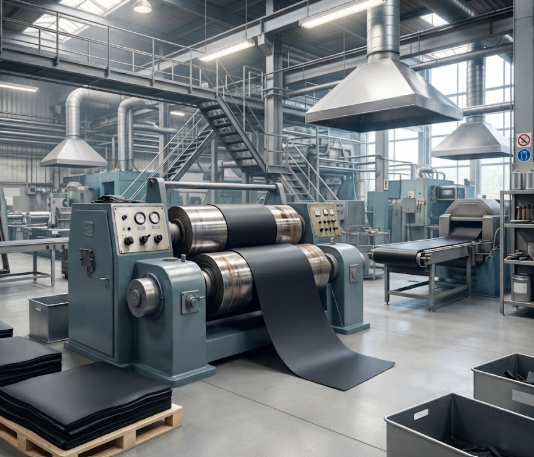
Rubber compound development is a material engineering process that determines how a rubber component performs under specific operating conditions. It involves selecting the right polymer, designing the formulation, controlling the mixing and curing processes, and validating the material against mechanical, thermal, and environmental requirements.
For industrial OEMs, the quality of a rubber compound can directly influence product reliability, manufacturing efficiency, and service life. A structured development process helps manufacturers create custom rubber compounds that meet application requirements while maintaining consistent performance during production.
What Is Rubber Compound Development?
Rubber compound development is the process of designing, formulating, and validating rubber materials for specific applications. It transforms a base rubber polymer into an engineered compound by incorporating fillers, plasticizers, curing agents, and functional additives.
A base polymer provides the fundamental characteristics of the material, but it does not determine every property of the finished compound. Two compounds made from the same polymer can have significantly different hardness, tensile strength, compression set, and environmental resistance because of differences in formulation and processing.
This is why rubber product development must consider material formulation and manufacturing conditions together. Polymer selection, ingredient proportions, filler dispersion, mixing parameters, and curing behavior all contribute to the performance of the final component.
Step 1: Define the Industrial Application and Performance Requirements
Identify Operating Conditions and Failure Risks
The first step in rubber compound development is understanding how the component will function in its actual operating environment. Engineers need to identify exposure to temperature, oils, fuels, chemicals, moisture, ozone, ultraviolet radiation, mechanical loads, vibration, friction, and compression.
The expected service life and maintenance interval are also important considerations. A rubber seal exposed to continuous compression has different material requirements from a vibration isolator subjected to repeated dynamic loading and heat buildup.
Understanding the likely failure mechanism helps narrow the material selection process. For example, a seal experiencing excessive swelling in oil requires a different formulation strategy from a rubber mount that loses performance because of fatigue or thermal degradation.
Translate Application Needs into Material Specifications
Once operating conditions are understood, engineers translate them into measurable material requirements. These may include Shore A hardness, tensile strength, elongation at break, tear strength, compression set, and resistance to heat aging or chemical exposure.
Each specification should relate to the component's actual function. A sealing application that remains compressed for extended periods may require particular attention to compression set, because excessive permanent deformation can reduce sealing effectiveness even when the material has acceptable tensile strength.
Step 2: Select the Right Rubber Polymer
Match Polymer Properties to Industrial Environments
Polymer selection establishes the foundation of a custom rubber compound. Common industrial elastomers include EPDM, NBR, HNBR, silicone, FKM, and natural rubber, each offering a different balance of performance characteristics.
EPDM is often selected for outdoor seals and industrial gaskets because of its weathering, ozone, and water resistance. NBR is commonly used in applications involving oils and fuels, while HNBR can provide improved heat and oil resistance for demanding operating conditions.
Silicone is useful when flexibility across a wide temperature range is required. FKM is selected for many applications involving elevated temperatures, oils, and chemicals, although compatibility depends on the specific grade and exposure medium. Natural rubber offers elasticity, resilience, and fatigue resistance for suitable mechanical applications.
Understand Polymer Limitations and Trade Offs
No single rubber polymer is ideal for every industrial environment. A material that performs well against oils may not provide the same weathering resistance or low temperature flexibility as another elastomer.
Engineers must evaluate chemical compatibility, operating temperature, dynamic loading, expected service life, cost, and manufacturing requirements together. Effective custom rubber compound research begins by identifying the most important performance requirements rather than selecting a polymer based on one property alone.
Step 3: Design the Rubber Compound Formulation
Select Fillers, Plasticizers, and Functional Additives
After selecting the base polymer, engineers determine which ingredients are needed to achieve the target material properties. Carbon black and silica can provide reinforcement, while plasticizers and process oils can influence flexibility, viscosity, and processability.
Antioxidants and antiozonants help protect suitable formulations against degradation caused by heat, oxygen, or ozone. Curing agents and accelerators establish the vulcanization system, while processing aids can support mixing and manufacturing efficiency.
The effect of each ingredient depends on the complete formulation. Increasing reinforcement may improve certain strength or abrasion characteristics, but it can also increase compound stiffness and affect processing behavior.
Balance Performance, Processability, and Cost
Rubber formulation is a multi variable optimization problem. Engineers must balance hardness, tensile strength, elongation, resilience, heat buildup, compression set, and processing requirements rather than optimizing a single property in isolation.
Formulations are commonly expressed using phr, or parts per hundred rubber. This system defines ingredient quantities relative to 100 parts by weight of the base rubber, allowing engineers to compare and document formulations consistently.
However, the same phr values do not guarantee identical results across different raw material grades or production conditions. Formulation development must therefore be supported by controlled mixing, testing, and iterative adjustment.
Step 4: Optimize the Rubber Mixing and Compounding Process
Control Mixing Equipment, Temperature, and Sequence
A well designed formulation must be processed correctly to achieve its intended properties. Industrial rubber technology compounding may use internal mixers such as Banbury mixers, along with open two roll mills for specific mixing, blending, and finishing operations.
Important process variables include ingredient addition sequence, mixing time, rotor speed, fill factor, and compound temperature. These variables influence how ingredients are incorporated, how fillers disperse, and how the compound responds during subsequent processing.
Mixing conditions must be developed for the specific formulation and equipment. A process that works for one compound may not be suitable for another because polymer characteristics, filler loading, and additive systems can change the material's response to shear and heat.
Prevent Dispersion Problems and Premature Curing
Poor filler dispersion can create inconsistent mechanical properties and reduce the reliability of the finished rubber component. Excessive heat generation can also degrade material characteristics or initiate premature curing, commonly referred to as scorch.
Engineers must control mixing energy, temperature, and ingredient sequence to maintain suitable compound quality and processability. Curing ingredients are often incorporated during a later mixing stage to reduce the risk of premature vulcanization.
Mixing energy and dump temperature are useful process indicators, but their target values must be established for the specific compound and mixer. Consistent production depends on controlling the complete process rather than applying one fixed mixing setting to every formulation.
Step 5: Test and Validate the Rubber Compound
Evaluate Mechanical and Physical Properties
Laboratory testing determines whether a developed compound meets its material specifications. Common evaluations include hardness under ASTM D2240, tensile strength and elongation under ASTM D412, tear resistance under ASTM D624, and compression set under ASTM D395.
Curing characteristics can be evaluated using a moving die rheometer under ASTM D5289. Rheometer data helps engineers assess scorch time, cure development, and other characteristics that influence the processing window.
These tests provide complementary information about material behavior. Hardness alone, for example, cannot establish whether a compound has sufficient tensile strength, low compression set, or adequate resistance to environmental aging.
Validate Performance Under Application Specific Conditions
Additional testing should reflect the conditions the component will encounter in service. Depending on the application, this may include heat aging, fluid immersion, ozone resistance, low temperature flexibility, or dynamic fatigue testing.
The test program should be based on the actual operating environment and the customer's acceptance criteria. Testing every possible property is not always necessary, but the selected evaluations must address the most relevant failure risks.
Use Test Results to Refine the Formulation
Rubber compound development is an iterative process. When a test result falls outside the target specification, engineers investigate the cause, adjust the formulation or process, and repeat the relevant tests.
Rheometer results can help explain curing behavior, but they do not replace validation under actual product conditions. A compound that performs well in laboratory specimens may still require further development before it can reliably meet the requirements of a molded component.
Step 6: Validate the Compound in the Final Rubber Product
Evaluate Molding, Curing, and Dimensional Stability
Material qualification is not the same as product validation. Once a compound meets its material specifications, it must be evaluated in the actual component, such as a gasket, seal, vibration isolator, or molded rubber part.
The evaluation may include mold filling, cure uniformity, flash, dimensional variation, and other manufacturing defects. Mold geometry, curing conditions, and component design can influence the final result even when the incoming compound is consistent.
Confirm Repeatability Before Mass Production
Before approving a compound for routine production, manufacturers should verify that it can be processed consistently under defined manufacturing conditions. Pilot production and process parameter verification help identify potential issues before production volumes increase.
Repeatability across batches is equally important. The compound must maintain its required characteristics while the manufacturing process remains stable, allowing the finished component to meet specifications throughout regular production.
Common Challenges in Industrial Rubber Compound Development
Several challenges can arise during development, and each requires a systematic engineering response. Excessive compression set may require a review of polymer selection, curing system, and crosslink structure, while poor tensile or tear performance may indicate issues with reinforcement, filler dispersion, or polymer filler interaction.
Premature curing can result from insufficient scorch safety or unsuitable mixing conditions. Inconsistent batch properties may be linked to raw material variation, weighing accuracy, mixing energy, or inadequate process control.
Chemical degradation requires careful evaluation of the compound against the actual fluid or chemical exposure, including operating temperature and exposure duration. Rather than changing ingredients without a clear diagnosis, engineers should use test results and failure analysis to identify the most likely cause.
How to Choose a Rubber Compound Development Partner
Selecting a rubber compound development partner requires evaluating both technical expertise and manufacturing capability. A suitable supplier should understand application requirements, recommend appropriate polymers, develop formulations, control mixing processes, and provide relevant material testing and documentation.
OEMs should also assess the supplier's ability to conduct trials, troubleshoot processing issues, optimize manufacturing parameters, and maintain batch traceability. These capabilities help connect material development with the requirements of repeatable production.
A qualified partner should explain why a particular compound is suitable for the application, including its limitations and the tests used to validate it. This is more valuable than selecting a material based only on its polymer name or hardness value.
Banshu Rubber Indonesia: Custom Rubber Compounding for Industrial Applications
Banshu Rubber Indonesia supports industrial customers seeking rubber solutions for application specific requirements. For OEMs evaluating custom rubber compounds, the development discussion should begin with the component's operating environment, required material properties, manufacturing process, and expected service life.
A structured engineering approach connects material requirements with formulation, compounding, product validation, and production needs. This helps customers evaluate whether a proposed rubber solution is appropriate for both the intended application and its manufacturing requirements.
If your project requires a custom rubber compound, discuss your application requirements and material specifications with Banshu Rubber. Discuss Your Industrial Rubber Compound Requirements with Banshu Rubber.