
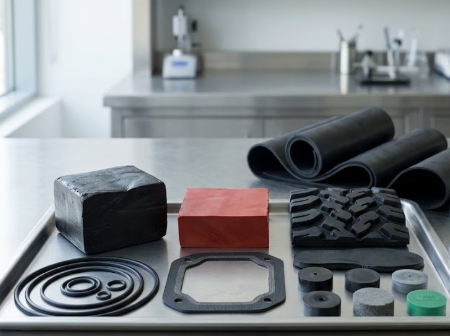
Rubber compound formulation is one of the most important engineering activities in the production of reliable elastomer components. The performance of a rubber part is not determined by the base polymer alone, but by the interaction between the polymer, fillers, plasticizers, curing system, protective additives, processing conditions, and manufacturing process.
For an OEM, specifying a rubber compound simply by hardness or polymer type is rarely sufficient for demanding applications. A component may require a specific combination of tensile strength, compression set, abrasion resistance, temperature resistance, chemical resistance, flexibility, and long term aging performance.
This is why custom rubber compound formulation is used when standard commercial compounds cannot provide the required balance of properties. The formulation engineer must translate the functional requirements of the component into measurable material targets and then develop a compound that can consistently achieve those targets in production.
Understanding Rubber Compound Formulation
Rubber compound formulation is the process of selecting and proportioning elastomers, fillers, plasticizers, curing agents, antioxidants, antiozonants, processing aids, and other additives to create a material with defined performance characteristics. Unlike many engineering metals, rubber does not have a single universal material specification that completely describes its behavior in every application.
Two compounds can use the same base polymer and still perform very differently because of differences in filler loading, curing chemistry, plasticizer selection, polymer grade, and processing history. The formulation therefore acts as an engineered material system rather than simply a mixture of ingredients.
A compounder begins with the properties required by the application and works backward toward the formulation. This approach is particularly important for seals, gaskets, bushings, mounts, hoses, vibration isolators, and other components where material behavior directly affects product reliability.
The objective is not to maximize every property simultaneously. Rubber formulation is fundamentally an optimization exercise because improving one property can sometimes reduce another.
Mapping Formulation to Rubber Material Properties
The most important skill in formulation development is understanding the relationship between ingredients and rubber material properties. Engineers must know how changes in polymer structure, filler type, filler loading, plasticizer level, and crosslink density influence the final compound.
Hardness and Modulus
Shore A hardness is one of the most commonly specified properties for molded rubber components. However, hardness should not be considered independently because modulus, compression behavior, elasticity, and dynamic response can also influence how the component functions.
Increasing reinforcing filler content can generally increase hardness and modulus, although the exact response depends on the polymer and filler system. Carbon black structure, particle size, surface characteristics, and loading level all influence reinforcement.
Plasticizers generally have the opposite effect by reducing compound viscosity and increasing flexibility. However, excessive plasticizer can reduce modulus and tensile performance and may also introduce concerns related to migration or extraction.
For this reason, achieving a target hardness is not simply a matter of adding more filler or oil. The compounder must consider how the change affects the entire performance profile.
Tensile Strength and Abrasion Resistance
Tensile strength depends on the elastomer, reinforcement system, crosslink structure, and processing conditions. Carbon black is widely used as a reinforcing filler because its interaction with the polymer can significantly improve strength, modulus, and abrasion resistance.
Different carbon black grades produce different reinforcement behavior. A grade such as N330 may provide a useful balance of reinforcement and processability for many applications, but the appropriate filler must be selected based on the required properties and polymer system.
Increasing reinforcement does not necessarily improve tensile strength indefinitely. Excessive filler loading can increase viscosity, reduce processability, and potentially create dispersion problems if the mixing process cannot properly incorporate the filler.
Abrasion resistance also depends on the interaction between polymer type, filler system, crosslink density, and service conditions. A compound optimized for abrasion in one environment may not provide the same performance under elevated temperature or chemical exposure.
Compression Set and Thermal Performance
Compression set is critical when rubber components must maintain sealing force over extended periods. A material with poor compression set resistance can gradually lose its ability to recover after prolonged compression, potentially resulting in leakage or loss of mechanical function.
The curing system has an important influence on compression behavior. Sulfur curing produces different crosslink structures compared with peroxide curing, and these differences can affect heat resistance, compression set, elasticity, and dynamic properties.
Peroxide curing creates carbon to carbon crosslinks that can provide strong thermal stability. Sulfur systems can provide excellent mechanical and dynamic performance for many elastomers, but their thermal behavior depends on the specific cure system and crosslink structure.
The correct choice therefore depends on the application rather than on the assumption that one curing system is universally superior. Temperature exposure, compression duration, dynamic loading, polymer type, and required service life should all be considered.
Environmental and Chemical Resistance
Environmental durability is another major formulation consideration. Rubber components may be exposed to oxygen, ozone, ultraviolet radiation, water, fuels, lubricants, cleaning chemicals, or other aggressive substances throughout their service life.
Antioxidants help reduce degradation associated with oxidation and elevated temperature. Antiozonants such as 6PPD can provide protection against ozone related degradation in formulations where their use is appropriate.
Paraffinic waxes can also contribute to surface protection by migrating toward the rubber surface and forming a protective layer. The effectiveness of this protection depends on the polymer, formulation, environmental conditions, and wax characteristics.
Polymer selection remains the first line of defense against environmental exposure. EPDM, for example, is commonly selected for weathering and ozone resistance, while NBR is generally preferred when resistance to petroleum based oils is a primary requirement.
The formulation engineer must therefore match the polymer and additive package to the actual exposure profile rather than selecting additives independently.
Building Custom Rubber Compound Formulation
A custom rubber compound formulation begins with a clear definition of the application. Engineers need to understand the operating temperature range, chemical exposure, mechanical loading, compression conditions, dynamic movement, environmental exposure, and expected service life.
The component itself must also be considered. A static gasket has different requirements from a dynamic seal, while an engine mount has different requirements from a hose or vibration isolator.
Once the application requirements are established, engineers translate them into measurable material targets. These can include hardness, tensile strength, elongation, modulus, compression set, abrasion, heat aging, fluid resistance, ozone resistance, and cure characteristics.
The formulation can then be developed around those targets. Instead of asking which polymer is best, the more useful engineering question is which combination of polymer, reinforcement, curing system, and additives provides the required property balance.
The Role of phr in Rubber Formulation
Rubber formulations are commonly expressed using phr, or parts per hundred rubber. The polymer or total rubber base is assigned a value of 100, and every other ingredient is expressed relative to that reference.
For example, a formulation could contain 100 phr of polymer, 50 phr of carbon black, and 10 phr of processing oil. The actual batch weight can then be scaled according to the required production quantity while maintaining the same formulation ratios.
The phr system provides a consistent framework for formulation development. It allows compounders to compare formulations, adjust ingredient concentrations, and scale recipes from laboratory batches to production batches.
However, maintaining the same phr values does not automatically guarantee identical production behavior. Mixing equipment, shear history, temperature, ingredient quality, and dispersion can all influence the final compound.
Developing Proprietary Rubber Formulations
Proprietary rubber formulations are developed when a manufacturer creates a controlled formulation specifically designed around an application, customer requirement, or performance target. The formulation may use commercially available raw materials, but the specific combination, ratios, processing conditions, and accumulated development knowledge can represent valuable proprietary know how.
The development process generally begins with application requirements and material benchmarking. Engineers may evaluate an existing compound, identify its strengths and limitations, and then modify the formulation to improve selected properties.
This can be particularly valuable when an OEM needs to replace a legacy material. A discontinued compound does not necessarily require redesigning the entire component if a new formulation can reproduce the required functional characteristics within an acceptable qualification process.
Proprietary rubber formulations can also provide differentiation when a component must operate under unusually demanding conditions. The formulation can be optimized around a specific combination of temperature, chemical exposure, mechanical stress, durability, and processing requirements.
Protection of formulation know how is therefore an important consideration. Confidentiality agreements, controlled formulation access, documented change management, and clear ownership provisions can help protect the intellectual property developed during the engineering process.
Advanced Rubber Compounding and Process Optimization
Formulation chemistry alone cannot guarantee compound performance. The mixing process determines whether the selected ingredients are actually incorporated and dispersed correctly throughout the polymer matrix.
Advanced rubber compounding therefore combines formulation science with controlled mechanical processing. Internal mixer rotor speed, ram pressure, fill factor, mixing sequence, temperature, and discharge conditions can all influence filler dispersion and compound consistency.
Mixing Sequence
Ingredient addition sequence is particularly important when processing highly filled compounds. Polymer, filler, plasticizer, processing aids, and protective additives need to enter the mixer at appropriate stages so that the polymer can effectively accept and disperse the filler.
Adding oil too early can reduce the mechanical shear available for filler breakdown. Adding certain ingredients too late can make incorporation more difficult or increase the energy required to achieve uniform dispersion.
The optimal sequence depends on the formulation and mixer design. An experienced compounder therefore validates the mixing sequence experimentally rather than relying on a generic recipe.
Temperature Control
Temperature is one of the most important variables during rubber mixing. Mechanical energy generates heat through viscous deformation and friction, while the compound itself can behave differently as its temperature changes.
Excessive temperature during the masterbatch stage can accelerate degradation or alter processing behavior. During the final mixing stage, excessive temperature can create an even more serious problem because curing ingredients can begin to react prematurely.
Process engineers therefore establish controlled temperature windows for each mixing stage. Mixer cooling, rotor speed, batch size, ram pressure, and dump criteria must work together to maintain the required process conditions.
Filler Dispersion
Good filler dispersion is essential for consistent mechanical performance. Large agglomerates or poorly distributed filler can create localized weaknesses and contribute to variation between batches.
The compound must receive sufficient mechanical energy to break down filler agglomerates without generating excessive heat. This is one of the central challenges of advanced rubber compounding.
Equipment condition also matters. Changes in rotor clearance, rotor wear, chamber condition, or cooling performance can modify the mixing environment even when the programmed recipe remains unchanged.
Controlling the Vulcanization System
The curing system determines how the rubber polymer network develops during vulcanization. Engineers select the cure chemistry based on the required balance of cure speed, scorch safety, thermal stability, mechanical performance, and long term durability.
Sulfur systems can use different accelerator combinations to control cure rate and crosslink structure. Delayed action accelerators such as sulfenamides are commonly used when processing safety and controlled cure initiation are important.
Faster accelerator systems such as thiurams can provide rapid curing behavior but may require careful formulation and process control because excessive cure activity can reduce scorch safety.
The formulation engineer must therefore consider the complete cure system rather than focusing on sulfur or accelerator concentration alone. Cure kinetics, processing temperature, part thickness, mold cycle, and required service properties must all be aligned.
Laboratory Testing and Material Validation
A formulation should not move directly from laboratory development to mass production without systematic validation. Laboratory testing provides evidence that the compound can meet the required material specification and provides data for identifying formulation weaknesses.
Rheometer testing is commonly used to evaluate cure behavior. Cure curves provide information about scorch behavior, cure rate, torque development, and the development of the crosslinked network.
Tensile testing provides information about tensile strength and elongation, while hardness testing provides a practical indicator of the material's resistance to indentation. Compression set testing is particularly important for sealing applications where the compound must maintain recovery after prolonged compression.
Accelerated aging tests can provide additional information about durability. Heat aging, ozone exposure, and fluid immersion can be used to evaluate how material properties change after exposure to conditions representative of the intended service environment.
The specific test methods and acceptance criteria should be established according to the component specification and applicable industry standards. ASTM methods such as ASTM D412 for tensile properties and ASTM D395 for compression set can form part of this qualification framework.
Formulation Development Is an Iterative Process
The first laboratory formulation rarely represents the final production compound. Engineers typically develop an initial formulation, test its properties, identify deviations from the target, and then adjust selected ingredients.
If hardness is too high, for example, the solution may involve modifying filler loading or plasticizer level. However, the engineer must then verify whether the change negatively affects tensile strength, compression set, abrasion resistance, or processing behavior.
The same principle applies when improving tensile strength or compression set. A formulation change should always be evaluated against the complete specification rather than a single property.
This iterative process is what transforms formulation from simple ingredient selection into material engineering. The final compound is the result of controlled experimentation supported by test data and process knowledge.
Balancing Performance, Cost, and Regulatory Requirements
A high performance compound is not automatically the best commercial formulation. For OEM production, the formulation must provide the required technical performance while remaining economically viable and manufacturable at the required production volume.
Ingredient cost is only one part of the equation. A more expensive polymer or filler may provide better durability and reduce field failures, while an apparently inexpensive formulation may create higher scrap, shorter component life, or difficult processing.
Regulatory requirements can also affect formulation choices. Depending on the application and market, manufacturers may need to consider requirements related to restricted substances, chemical declarations, food contact, drinking water applications, or customer specific material restrictions.
The formulation engineer must therefore balance technical performance, cost, manufacturability, regulatory compliance, and supply chain availability. This balance becomes particularly important when the compound is intended for long term OEM production.
From Laboratory Formula to Production
Scaling a formulation from laboratory equipment to industrial mixing equipment is a critical stage of rubber compound development. A laboratory batch experiences different thermal and mechanical conditions from a production batch, even when the ingredient ratios are identical.
Production scale up should therefore establish the appropriate mixing sequence, rotor conditions, fill factor, temperature profile, energy input, and discharge criteria. The objective is to reproduce the material behavior demonstrated during laboratory development.
Batch consistency should then be verified through laboratory testing and production monitoring. Tracking rheological properties, hardness, tensile properties, and other critical characteristics helps identify process drift before it affects finished components.
This connection between formulation and manufacturing is particularly important for proprietary rubber formulations. A proprietary recipe has commercial value only when the manufacturer can reproduce its performance reliably across production batches.
Choosing a Rubber Formulation Partner
For OEMs, the selection of a formulation partner should extend beyond the supplier's ability to mix rubber. The partner should have the technical capability to develop formulations, conduct laboratory testing, scale compounds to production, and maintain consistent quality over the lifetime of the program.
An in house laboratory provides an important advantage because formulation adjustments can be evaluated without relying entirely on external testing. The ability to connect laboratory results with production mixing data also creates a stronger feedback loop for process improvement.
Manufacturing capability is equally important. The supplier should understand how the formulation behaves in actual internal mixers, open mills, molding equipment, and other downstream processes.
Quality systems, material traceability, change control, raw material sourcing, MOQ flexibility, lead time, and regulatory compliance should also be evaluated during supplier qualification. For international OEM programs, these factors can have as much commercial importance as the initial formulation cost.
Rubber compound formulation is the engineering process that transforms an application requirement into a controlled material specification. The final rubber material properties are determined by the combined effects of polymer selection, reinforcement, plasticizers, curing chemistry, protective additives, mixing conditions, and vulcanization.
A successful custom rubber compound formulation does not attempt to maximize one property in isolation. Instead, it establishes the right balance between hardness, modulus, tensile strength, compression set, abrasion resistance, environmental resistance, thermal stability, processability, cost, and regulatory requirements.
Proprietary rubber formulations can provide significant value when standard compounds cannot satisfy demanding applications or when OEMs need to replace legacy materials. Their value comes from validated material performance and reproducible manufacturing knowledge, not simply from having a unique formulation.
Advanced rubber compounding strengthens this development process by connecting formulation chemistry with controlled mixing, temperature management, filler dispersion, cure control, and laboratory verification. This integrated approach reduces the risk of discovering material problems only after production has started.
For OEMs and industrial manufacturers, the most reliable path is to work with a compounding partner that can support the complete development cycle. From application analysis and laboratory formulation through testing, scale up, and production control, disciplined rubber engineering provides the foundation for consistent components and long term product reliability.