
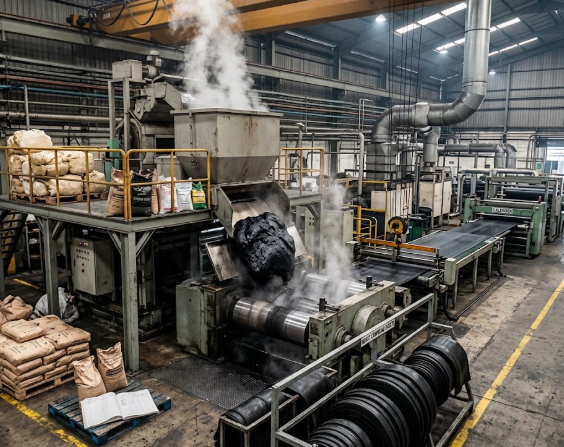
The rubber mixing process is one of the most critical operations in rubber manufacturing because compound quality is largely determined before the material ever reaches the molding or extrusion stage.
A compound can have the correct formulation on paper and still produce inconsistent parts if polymer breakdown, filler dispersion, temperature control, or ingredient incorporation is not properly managed.
For rubber manufacturers, the objective of rubber mixing is not simply to combine raw materials. The process must create a controlled and repeatable compound in which polymers, fillers, plasticizers, processing aids, protective agents, and curing ingredients are incorporated with the required level of dispersion and distribution.
Modern rubber mixing therefore combines material science, mechanical processing, thermal management, process automation, and laboratory verification.
For OEM applications, this control becomes especially important because small variations in compound rheology can influence molding behavior, dimensional stability, curing characteristics, and finished part performance.
What Is the Rubber Mixing Process
The rubber mixing process is the controlled mechanical incorporation of different compounding ingredients into an elastomer matrix. Typical ingredients can include natural rubber or synthetic polymers such as EPDM, NBR, SBR, silicone, or fluorocarbon elastomers, together with carbon black, silica, plasticizers, antioxidants, processing aids, and curing systems.
The process has two fundamental objectives, distributive mixing and dispersive mixing. Distributive mixing seeks to distribute ingredients throughout the polymer matrix, while dispersive mixing breaks down agglomerates and incorporates fillers into the polymer so that the resulting compound has consistent physical and rheological behavior.
This distinction is important because a compound can appear visually uniform while still containing poorly dispersed filler agglomerates. Those defects can later contribute to inconsistent processing, surface defects, premature failure, or variation in finished product properties.
The evolution of industrial rubber mixing has moved from relatively simple open mill operations toward sophisticated internal mixers, automated weighing systems, process monitoring, and computer controlled production systems. The result is a manufacturing environment where mixing can be monitored using multiple variables instead of relying only on operator experience.
Industrial Rubber Mixing Equipment
Internal Mixers
Internal mixers are the primary equipment used for high volume rubber compound production. Banbury type and intermix systems process rubber inside a closed chamber where rotors generate mechanical shear, compression, folding, and circulation.
A typical internal mixer contains a mixing chamber, rotors, ram, feeding system, temperature control system, and discharge mechanism. During operation, the rotors continuously deform the rubber and move it through different flow regions while the ram maintains pressure on the material.
Internal mixer performance depends heavily on rotor geometry and operating conditions. Tangential rotor systems and intermeshing rotor systems create different material flow patterns, shear conditions, fill requirements, and energy profiles.
Tangential rotors operate with rotor tips passing through the material at different relative speeds. This frictional speed difference contributes to shear and is commonly used for masterbatch and final mixing operations.
Intermeshing rotors use a more interlocking geometry that creates intensive material circulation between the rotors. This configuration can provide strong distributive and dispersive mixing while operating with different fill and energy characteristics compared with tangential systems.
Rotor wing configuration also affects the way rubber moves through the chamber. Modern mixing systems can use different rotor geometries to improve filler incorporation, shorten cycle times, control temperature rise, and increase production consistency.
The appropriate mixer is therefore not selected only according to batch size. Polymer type, filler system, compound viscosity, target dispersion, production volume, thermal sensitivity, and required cycle time all influence equipment selection.
Two Roll Open Mills
Two roll open mills remain important in rubber processing even when internal mixers are used for the primary mixing operation. Open mills are commonly used for sheeting, drop milling, temperature reduction, blending, and certain final mixing operations.
Large industrial mills can be configured for different production requirements, while stock blenders and automated handling systems can improve consistency during sheet formation. The mill also provides an opportunity for operators and process engineers to observe the compound condition before it moves to the next production stage.
Modern rubber plants can combine internal mixers, open mills, automated weighing systems, micro ingredient feeders, batch off systems, and material tracking. The integration of these systems helps reduce manual variation and improves traceability throughout the rubber compound mixing process.
Stages of the Rubber Compound Mixing Process
Stage 0: Raw Material Preparation and Mastication
Before full ingredient incorporation begins, raw materials must be prepared according to the approved formulation. Accurate weighing is essential because even a small deviation in an active ingredient can affect compound viscosity, cure behavior, hardness, compression set, or long term durability.
Mastication may be used when the polymer requires controlled breakdown before additional ingredients are introduced. Mechanical working reduces polymer viscosity and can improve the ability of the material to accept fillers and other compounding ingredients.
The objective is not simply to reduce viscosity as much as possible. Excessive mastication can alter molecular structure and potentially affect the final compound properties, so the amount of mechanical work must be controlled according to the polymer and formulation.
Stage 1: Masterbatch Mixing
The first major stage is commonly referred to as the masterbatch pass. The polymer is charged into the mixer together with selected fillers, plasticizers, processing aids, and protective ingredients according to the established mixing recipe.
For an EPDM compound, for example, the formulation may contain EPDM polymer, carbon black or silica, process oil, antioxidants, and other additives. An NBR compound may require a different sequence because its polarity, viscosity, filler interaction, and oil compatibility can influence the mixing behavior.
Ingredient addition sequence is one of the most important aspects of the rubber mixing process. The sequence determines when the polymer becomes capable of accepting fillers, how efficiently fillers are incorporated, and how much mechanical energy is required to reach the desired dispersion.
Different mixing strategies can be used depending on the compound formulation. Terms such as right side up mixing, upside down mixing, Y mixing, and slush mixing describe different approaches to ingredient addition and processing sequence.
Oil addition is another important process decision. If oil is added too early, it can reduce the effective shear available for filler breakdown and dispersion. If it is added too late, the polymer may already have developed a structure that makes uniform incorporation more difficult.
The optimum sequence must therefore be established experimentally for the specific polymer and filler system. A mixing recipe that works well for one EPDM formulation may not provide the same result for an NBR or silicone compound.
Intermediate Sheeting and Cooling
After the masterbatch reaches the required condition, the compound is discharged from the internal mixer. The material may then pass through an open mill or other processing equipment to form sheets and reduce temperature.
Cooling is particularly important because the compound may retain significant thermal energy after intensive mechanical mixing. The material must be cooled sufficiently before the next mixing stage to prevent premature reaction of curing ingredients.
A controlled rest period can also be used between mixing stages. The rest period allows the compound to stabilize thermally and physically before the final ingredients are introduced.
Stage 2: Final Pass and Curative Addition
The second mixing stage incorporates curing ingredients such as sulfur, accelerators, and other curatives. This stage is often performed under lower temperature conditions than the masterbatch pass because excessive heat can initiate premature vulcanization.
The objective is to distribute the curatives uniformly without allowing the compound to begin curing inside the mixer. If scorch begins during mixing, the compound can become difficult or impossible to process correctly.
For this reason, final pass temperature control is one of the most important elements of rubber mixing. Dump temperature, rotor speed, mixing time, and cooling conditions must work together to protect the compound from premature crosslinking.
Key Process Parameters in Rubber Mixing
Rotor Speed and Speed Differential
Rotor speed directly influences shear rate, material circulation, cycle time, and heat generation. Increasing rotor speed can accelerate filler incorporation, but the additional mechanical energy also increases the rate of temperature rise.
In tangential mixing systems, the relative speed between rotors contributes significantly to shear generation. Process engineers therefore need to balance mixing intensity with thermal limitations rather than assuming that higher rotor speed always produces better dispersion.
Ram Pressure
Ram pressure determines how effectively the material is compressed into the rotor region. Adequate ram pressure improves contact between the polymer and rotor surfaces and can increase material circulation through high shear regions.
Insufficient pressure may reduce the effectiveness of the mixing action, while excessive pressure can increase mechanical loading and heat generation. The correct setting depends on mixer design, compound viscosity, fill level, and formulation.
Chamber Fill Factor
Fill factor describes how much of the available mixing chamber volume is occupied by material. In many industrial applications, an operating range around 65 percent to 75 percent may be used as a starting point, but the appropriate range must be validated for the specific mixer and compound.
An underfilled chamber can reduce the effectiveness of ram action and material circulation. An overfilled chamber can restrict movement, create inefficient flow regions, increase loading, and reduce the consistency of dispersion.
The correct fill factor is therefore a process optimization variable rather than a universal number. Mixer geometry, rotor design, formulation density, polymer viscosity, and batch size all influence the optimum condition.
Thermal Management
Heat generation is unavoidable during rubber mixing because mechanical energy is converted into heat through friction and viscous deformation. The challenge is to generate enough mechanical energy for proper filler dispersion without allowing the compound temperature to exceed the safe processing window.
Cooling water temperature, chamber cooling, rotor cooling, rotor speed, ram pressure, batch size, and mixing sequence all contribute to thermal behavior. Temperature should therefore be treated as a process variable rather than simply a final measurement.
Equipment Wear and Clearance
Mixer condition has a direct influence on compound consistency. Rotor tip wear, chamber wear, and changes in rotor clearance can modify the flow path and shear conditions inside the mixer.
As clearance increases, the mechanical interaction between the rotor and compound can change. The same mixing recipe can therefore produce a different result after significant equipment wear even when the programmed speed, time, and temperature settings remain unchanged.
Maintenance should consequently be connected to process performance. Monitoring batch energy, temperature profiles, cycle time, and laboratory results can help identify gradual equipment deterioration before it becomes a major quality problem.
How Dump Control Improves Rubber Mixing Consistency
One of the most important process decisions is determining when the compound should be discharged from the mixer. Traditional systems may rely primarily on mixing time, but time alone does not always represent the actual condition of the material.
Time Based Dumping
Time based dumping is simple and easy to implement. The mixer runs for a predefined duration and then automatically discharges the batch.
The weakness of this approach is that material conditions can change from batch to batch. Variations in raw material viscosity, moisture, filler characteristics, initial temperature, or equipment condition can cause the same mixing time to produce different compound conditions.
Temperature Based Dumping
Temperature based dumping uses compound temperature as a primary control criterion. This approach is particularly useful when the formulation has a defined thermal sensitivity or when curatives must be protected from premature reaction.
Temperature control should still be combined with other process indicators because the same temperature does not necessarily mean the same level of dispersion. The material can reach a target temperature through different combinations of shear, time, and friction.
Energy Based Dumping
Energy based control uses cumulative mechanical energy input as an additional indicator of mixing progress. Monitoring energy input in terms of kilowatt hours can provide a more direct representation of the mechanical work applied to the compound than time alone.
Energy based control can be particularly useful for improving batch to batch consistency because it considers changes in mixer load during the cycle. When combined with temperature and laboratory data, it can become a powerful process control method.
The most robust strategy is therefore not necessarily to choose one control method. A modern rubber mixing process can use time, temperature, torque, energy, and laboratory verification together to establish a more reliable process window.
Quality Assurance in the Mixing of Rubber Compounds
Quality control should not begin after molding. The compound itself must be verified before it is released to downstream manufacturing processes.
A rubber compound laboratory can evaluate viscosity, cure behavior, rheological properties, hardness, tensile properties, elongation, compression characteristics, dispersion, and other specifications depending on the application.
For automotive and other demanding industrial applications, the objective is to establish a traceable relationship between the formulation, mixing conditions, laboratory results, and production performance. This approach allows manufacturers to identify process drift before it creates large quantities of nonconforming parts.
Rheological Verification with Rubber Process Analyzers
Rubber Process Analyzers are valuable tools for understanding the rheological behavior of unvulcanized compounds. ASTM D6204 covers the measurement of unvulcanized rheological properties using rotorless shear rheometers and states that these properties can relate to factory processing behavior. The current active edition is ASTM D6204 26.
ASTM D8059 is specifically used to measure unvulcanized dynamic strain softening, commonly known as the Payne Effect. The current ASTM listing identifies D8059 26 as the active edition, and the method relates strain amplitude measurements to filler network behavior and can be used to evaluate effects associated with carbon black or silica dispersion from the mixing process.
These tests should not be interpreted as a single pass or fail indicator for overall compound quality. Instead, they become most valuable when used as part of a historical process database that allows engineers to compare current batches with established reference ranges.
Carbon black dispersion can also be evaluated using ASTM D2663. The current ASTM listing identifies D2663 14R25 as an active version, with methods addressing the degree of carbon black dispersion in rubber.
Connecting Mixing Parameters to Final Product Performance
The real value of a controlled rubber mixing process becomes visible during molding, extrusion, and final product testing. A well controlled compound should not only meet laboratory specifications but should also provide stable processing behavior on the production line.
For example, excessive variation in viscosity can influence injection pressure and mold filling. Poor filler dispersion can contribute to surface defects or inconsistent mechanical properties, while variation in cure behavior can affect cycle time and final crosslink density.
This is why rubber compound development should be treated as an integrated engineering process. Formulation, mixing equipment, process parameters, laboratory testing, molding conditions, and finished part requirements must be connected.
Why Rubber Mixing Requires More Than a Standard Mixing Recipe
A common misconception is that rubber compounding can be standardized simply by specifying ingredient quantities and mixing time. In practice, the same formulation can behave differently when processed on different mixers or under different equipment conditions.
Mixer geometry, rotor design, chamber volume, rotor clearance, cooling efficiency, raw material temperature, polymer viscosity, filler structure, and ingredient sequence can all influence the final compound.
For this reason, experienced compounders do not treat the mixing recipe as an isolated document. They treat it as a process system that must be validated against equipment capability, material behavior, laboratory results, and production requirements.
This engineering approach is especially important for custom rubber parts where the compound may need to meet specific requirements for temperature resistance, oil resistance, compression set, dynamic fatigue, weather resistance, electrical properties, or long term durability.
Choosing a Custom Rubber Mixing Partner
For OEMs, selecting a rubber manufacturing partner should involve more than evaluating whether the supplier can mix a particular polymer. The supplier should have the equipment, formulation capability, laboratory infrastructure, process control, and production experience required to translate a material specification into a repeatable manufacturing process.
A capable custom rubber manufacturer should be able to support the complete development chain from formulation and raw material selection through rubber mixing, laboratory verification, molding, inspection, and production scale up.
The ability to control the mixing process is particularly important when compounds are produced for high volume applications. A supplier may achieve acceptable results during initial trials, but the real test is whether the same compound can be reproduced consistently across hundreds or thousands of production batches.
The rubber mixing process is the foundation of consistent rubber manufacturing. Internal mixer selection, rotor geometry, ingredient sequence, fill factor, ram pressure, rotor speed, thermal management, and dump control all influence the final condition of the compound.
Effective rubber compound mixing process control also requires more than monitoring the mixer. Laboratory verification using appropriate rheological and dispersion methods provides the feedback required to connect processing conditions with compound behavior and finished product performance.
For manufacturers involved in mixing of rubber compounds, the most reliable approach is to treat formulation and mixing as an integrated engineering discipline. The objective is not simply to produce a batch that looks uniform, but to create a repeatable material with controlled rheology, predictable processing behavior, and stable performance in the customer's application.
For OEMs, this distinction can have a significant commercial impact. Consistent rubber mixing reduces variation downstream, supports stable molding and extrusion conditions, improves production efficiency, and provides a stronger foundation for long term product reliability.
A qualified custom rubber manufacturing partner can help OEMs develop and control this process from formulation through mass production. With the right combination of compounding expertise, mixing technology, laboratory verification, and process discipline, rubber mixing becomes more than a preparation step. It becomes a controlled engineering process that determines how reliably the final rubber component will perform.