
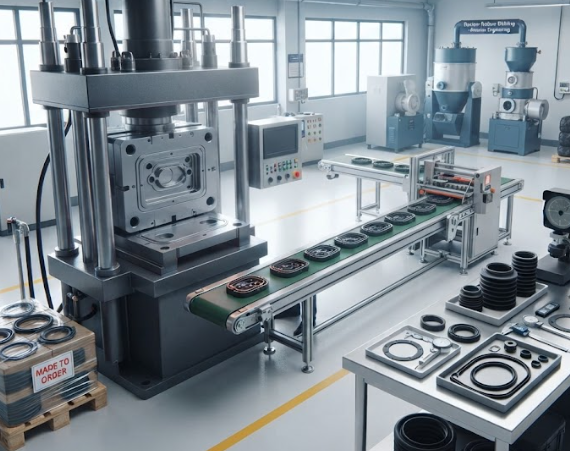
For OEMs, rubber components are rarely just supporting parts. A gasket determines whether a system can maintain a reliable seal. A vibration isolator influences noise, vibration, and durability. A hose or seal must maintain its properties despite temperature changes, chemicals, pressure, and repeated mechanical movement.
This is why developing custom rubber parts requires more than sending a drawing to a manufacturer and requesting a quotation. The material, component geometry, molding method, tooling design, production volume, and validation requirements all need to be considered before production begins.
In practice, many problems that appear during mass production can be traced back to decisions made during the early development stage. An unsuitable elastomer, unrealistic tolerance, poorly designed mold, or incorrect molding method can increase tooling costs, extend development time, and create quality problems later.
For OEMs, the most effective approach is to involve an experienced custom rubber parts manufacturer early in the project. The manufacturer can contribute manufacturing knowledge while the OEM provides the functional requirements of the component.
The result is a development process where design, material, tooling, and production are engineered together.
Understanding What Makes Custom Rubber Parts Different
Standard rubber products are manufactured according to predefined dimensions and material specifications. Customized rubber parts, on the other hand, are developed around a specific application.
This distinction is particularly important for OEM rubber parts.
A custom seal for an automotive transmission may require resistance to oil, elevated temperature, pressure, and repeated movement. A vibration isolator may prioritize dynamic fatigue performance and damping characteristics. An industrial gasket may require resistance to aggressive chemicals and compression set.
The part geometry can also influence material selection.
Thin sections may require a compound with suitable flow characteristics during molding. Thick sections may require careful control of curing because heat must reach the entire component. Tight dimensional requirements may require a specific molding technology and more sophisticated tooling.
Therefore, the first question should not be which rubber material should be used.
The better question is what the component needs to accomplish during its entire service life.
Choosing the Right Rubber Molding Process
One of the most important decisions in a custom rubber project is selecting the appropriate molding process.
Rubber injection molding, compression molding, and transfer molding can all produce high quality components, but their advantages are different.
Rubber Injection Molding
Rubber injection molding uses controlled pressure to inject a prepared rubber compound into closed mold cavities.
The process is particularly attractive for high volume production because material loading, injection, curing, and part removal can be highly automated.
For complex custom molded rubber parts, injection molding can provide excellent repeatability and efficient cycle times when the material and tooling are properly engineered.
However, injection molding generally requires more sophisticated equipment and tooling. The economics become more attractive as production volume increases because the tooling investment can be distributed across a larger number of components.
For an OEM expecting significant annual production volumes, injection molding may therefore provide a lower long term cost per component despite a higher initial investment.
Compression Molding Rubber
Compression molding places a predetermined amount of uncured rubber directly into the mold cavity. The mold is then closed, applying pressure and heat to form and cure the component.
The process is relatively straightforward and can be economically attractive for lower production volumes, larger components, or relatively simple geometries.
Compression molding can also provide greater flexibility during development because tooling can be less complex than tooling required for certain injection molding applications.
For prototype production or moderate annual volumes, compression molding may provide a better balance between tooling investment and manufacturing cost.
However, material loading and flash control need to be carefully managed to maintain consistent part quality.
Transfer Molding Rubber
Transfer molding places the rubber charge into a transfer chamber before pressure forces the material through gates into the mold cavities.
This process provides greater control over material placement than conventional compression molding and can be useful for components with more complex geometries.
Transfer molding is also commonly considered for rubber-to-metal bonding applications.
For example, an OEM may require a rubber component bonded to a metal insert for a mounting system, bushing, valve component, or vibration isolator. In these cases, mold design, surface preparation, adhesive selection, material flow, and curing conditions all need to be coordinated.
The best molding method therefore depends on more than component geometry. Production volume, material behavior, tooling cost, automation requirements, dimensional requirements, and part complexity should all be evaluated together.
Tooling Quality Directly Influences Part Quality
For OEMs developing custom rubber parts, tooling should be treated as an engineering asset rather than simply a production expense.
The mold determines how the compound flows, where the parting line is located, how air escapes from the cavity, how flash develops, and how the finished component is removed.
Poor tooling design can result in several recurring problems.
Uneven material flow can produce incomplete filling or dimensional variation. Inadequate venting can trap air inside the cavity and create surface defects. Poor parting line design can increase flash. Incorrect shrinkage compensation can create dimensional problems after curing.
These problems are particularly expensive when discovered after the mold has already been manufactured.
This is why design for manufacturability should be performed before tooling production begins.
An experienced manufacturer can review the OEM drawing and identify areas where geometry, tolerances, parting lines, draft requirements, or gate locations may create manufacturing difficulties.
The objective is not to change the functional requirements of the component. It is to find a manufacturing approach that achieves those requirements more efficiently.
Tooling Cost Is Not the Same as Total Project Cost
OEM purchasing teams often focus heavily on the initial mold quotation.
However, the lowest tooling price does not necessarily produce the lowest total project cost.
A poorly optimized mold may require longer cycle times, produce excessive flash, generate more material waste, require frequent maintenance, or create dimensional variation.
A better designed mold may cost more initially but produce a lower cost per part over several years of production.
For high volume rubber parts manufacturing, this difference can become substantial.
Tooling design should therefore be evaluated against expected annual volume, mold life, cycle time, number of cavities, maintenance requirements, material utilization, and quality performance.
An experienced custom rubber parts manufacturer should be able to explain these tradeoffs before the OEM commits to tooling.
What OEMs Should Prepare Before Requesting a Quotation
One of the most effective ways for an OEM to accelerate a custom rubber project is to prepare complete technical information before approaching manufacturers.
The first requirement is a clear definition of the application.
The manufacturer needs to understand operating temperature, chemical exposure, pressure, mechanical movement, environmental exposure, and expected service life.
For example, specifying that a seal operates at 250 degrees Fahrenheit provides useful information, but specifying that it operates continuously at 250 degrees Fahrenheit while exposed to hydraulic fluid and cyclic compression provides a much stronger basis for material selection.
Material Requirements
OEMs should provide an existing material specification if one already exists.
If the material has not yet been determined, the manufacturer should receive information about the operating environment so the engineering team can recommend suitable elastomers.
Potential materials may include NBR for oil resistance, EPDM for weather and ozone resistance, FKM for demanding chemical and temperature environments, or silicone for applications requiring wide temperature flexibility.
The correct selection depends on the actual application rather than simply the material's general reputation.
CAD and Technical Drawings
Clear 2D drawings and 3D CAD files are extremely valuable during the development process.
The drawing should identify critical dimensions, tolerances, sealing surfaces, interfaces, and any dimensions that directly affect component functionality.
Not every dimension needs the same tolerance.
Applying unnecessarily tight tolerances to every feature can increase tooling and production costs without improving product performance.
This is one area where engineering collaboration can create significant savings.
The manufacturer can help identify which dimensions are functionally critical and which can use more practical manufacturing tolerances.
Annual Production Volume
Expected annual usage, often referred to as estimated annual usage, is another critical input.
A component requiring 5,000 pieces per year may justify a completely different molding strategy from a component requiring 500,000 pieces per year.
For lower volumes, compression molding may provide a more economical tooling strategy.
For high volume OEM rubber parts, injection molding may provide better long term economics through shorter cycle times, automation, and improved repeatability.
The expected volume should therefore be communicated as early as possible.
Engineering Support Should Begin Before the Mold Is Made
The strongest OEM and supplier relationships begin during development rather than after the purchase order is issued.
A capable manufacturer should be able to review the component design and discuss material selection, molding method, tooling architecture, tolerance requirements, and expected production conditions.
This engineering review can identify potential issues before they become expensive production problems.
For example, an OEM may specify a very thin sealing lip because of packaging constraints. The manufacturer may identify that the geometry creates filling challenges during molding and recommend a small geometry adjustment that maintains the sealing function while improving manufacturability.
This is the practical value of design for manufacturing.
The goal is not simply to make a component that can be manufactured.
The goal is to make a component that can be manufactured consistently, economically, and at the required production volume.
Validation Should Be Defined Before Production
Another important consideration is how the finished component will be validated.
Different rubber components require different validation methods.
A sealing component may require leakage testing, compression set evaluation, pressure testing, and thermal aging.
A vibration isolator may require dynamic testing, stiffness evaluation, fatigue testing, and environmental aging.
A component exposed to chemicals may require immersion testing to evaluate swelling, hardness change, tensile retention, and dimensional stability.
The acceptance criteria should ideally be established before production begins.
This gives the manufacturer a clear target and allows the formulation and process to be engineered around measurable performance requirements.
Standardized test methods such as ASTM and ISO procedures can provide a common basis for evaluation, but application specific validation is often necessary for critical OEM components.
What to Look for in a Custom Rubber Parts Manufacturer
Choosing the right supplier is one of the most important decisions in a custom rubber project.
An OEM should look beyond equipment lists and quoted unit prices.
The manufacturer should demonstrate expertise in compound development, rubber molding, tooling, quality control, and production engineering.
The ability to support design review is particularly valuable.
A supplier that only manufactures according to an existing drawing may not identify potential manufacturing problems until production begins.
A supplier with strong engineering capabilities can participate earlier and help optimize the design before tooling is committed.
Production scalability is another important factor.
The supplier should be able to demonstrate how the project can move from prototype or trial production into stable high volume manufacturing without major changes to the product or process.
Quality systems are also important for OEM applications. Depending on the industry, customers may require systems such as IATF 16949 for automotive manufacturing or ISO 9001 for broader quality management requirements.
The objective is to establish a supply chain capable of maintaining consistent compound, dimensional, and functional performance throughout the production lifecycle.
The Engineering Principle Behind Successful Custom Rubber Projects
The most successful custom rubber parts projects follow a simple engineering principle.
Do not optimize the part, material, tooling, and manufacturing process independently.
Optimize them as one system.
The elastomer influences flow and curing behavior. The formulation influences viscosity and mechanical properties. The geometry influences material flow and demolding. The tooling influences filling and dimensional stability. The molding process influences cycle time and consistency.
Changing one variable can affect the others.
This interconnected relationship is why early engineering collaboration can prevent expensive redesigns later.
For OEMs, the most valuable supplier is therefore not necessarily the one offering the lowest initial quotation. It is the manufacturing partner capable of helping the engineering team reach the required performance at the lowest practical total cost.
Developing custom molded rubber parts requires careful planning before production begins.
OEMs should define the operating environment, identify the required material characteristics, prepare accurate CAD and technical drawings, establish realistic tolerances, estimate annual production volume, and define validation requirements.
The molding method should then be selected according to the component geometry, material, production volume, tooling investment, and quality requirements. Injection molding can be highly effective for high volume production, while compression molding may be more economical for lower volumes or larger components. Transfer molding provides another option for complex geometries and components involving inserts.
Tooling should be developed collaboratively because mold design has a direct influence on part quality, material utilization, cycle time, and long term manufacturing cost.
For OEMs, these decisions become much easier when working with an experienced custom rubber parts manufacturer that can provide engineering support from the initial design review through production.
Banshu Rubber: Custom Rubber Parts for OEM Applications
Banshu Rubber supports OEM customers requiring engineered custom rubber parts and OEM rubber parts for demanding industrial and automotive applications.
Our approach combines rubber compound development, molding technology, tooling engineering, production control, and quality assurance to develop customized rubber parts around the actual requirements of each application.
From material selection and design review to tooling development, molding, finishing, and inspection, the objective is to create reliable rubber components that can be produced consistently at the required production volume.
For OEMs, custom rubber manufacturing should begin long before the mold is built. The earlier material, geometry, tooling, and production requirements are aligned, the lower the risk of costly changes later in the project.