
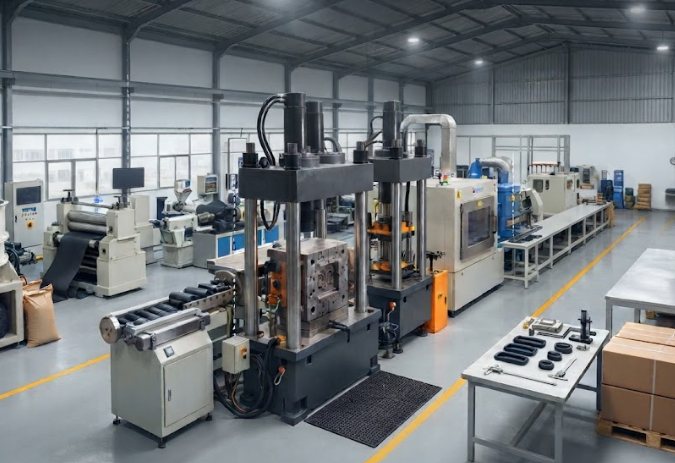
Rubber components are often small parts of a much larger industrial system, but their performance can determine whether that system operates reliably. Seals must prevent leakage, vibration mounts must absorb mechanical energy, hoses must withstand pressure and chemicals, and gaskets must maintain sealing force over long periods of operation.
Behind every reliable rubber component is a carefully controlled manufacturing process. The finished part is not created simply by placing rubber into a mold and heating it. The complete rubber parts manufacturing process begins with material selection and compound development, continues through mixing and forming, and ends with curing, finishing, inspection, and performance validation.
For industrial buyers, understanding this process is important because manufacturing decisions made during the early stages can directly influence dimensional stability, mechanical strength, chemical resistance, fatigue life, and long term reliability.
A high quality rubber component is therefore the result of several engineering disciplines working together. Material science determines the compound. Process engineering determines how the material is processed. Tooling engineering determines how the part is formed. Quality engineering verifies whether the finished component performs according to specification.
Material Selection Is the Starting Point
The first step in any rubber manufacturing process is selecting an elastomer that matches the actual operating environment.
Natural rubber offers excellent elasticity, tear resistance, and fatigue performance and is commonly considered for dynamic applications such as vibration isolators and heavy duty mounts.
Synthetic elastomers provide different combinations of chemical, thermal, and environmental resistance.
NBR is commonly selected for applications involving petroleum based oils, fuels, and hydraulic fluids. EPDM is widely used for outdoor applications because of its excellent resistance to ozone, weathering, water, and elevated temperatures. HNBR can provide improved thermal and mechanical performance compared with conventional NBR in demanding applications. FKM is frequently considered for aggressive chemicals, fuels, and elevated temperature environments. Silicone rubber is often selected when wide temperature capability and flexibility are important.
Material selection should also consider hardness, tensile strength, elongation, compression set, tear resistance, abrasion resistance, and expected service temperature.
From an engineering perspective, hardness should never be treated as the only material selection criterion. Two compounds can have the same hardness while exhibiting very different behavior when exposed to oil, heat, pressure, or repeated deformation.
The correct material is therefore not necessarily the material with the highest individual performance specification. It is the material that provides the right balance of properties for the application.
Compound Preparation Determines the Foundation of the Finished Part
Once the base elastomer has been selected, the next stage is compound preparation.
A rubber compound typically contains the base polymer together with reinforcing fillers, plasticizers, processing aids, antioxidants, antiozonants, curing agents, and other specialty chemicals.
Carbon black and silica are commonly used to reinforce the polymer matrix. They can improve tensile strength, tear resistance, abrasion resistance, hardness, and other mechanical characteristics.
Plasticizers can improve flexibility and processing behavior. Antioxidants and antiozonants help protect the compound against environmental degradation. Curing agents ultimately create the crosslinked polymer structure responsible for the elastic properties of the finished material.
The formulation must be carefully balanced because changing one ingredient can influence several compound properties at the same time.
Increasing reinforcing filler may improve tensile strength but also increase viscosity. Increasing plasticizer content may improve flexibility but can reduce certain mechanical properties. Increasing crosslink density can improve hardness and compression resistance but may reduce elongation.
This is why professional rubber parts manufacturing begins with formulation engineering rather than simply purchasing a generic rubber material.
The Rubber Mixing Process
After formulation, the ingredients must be incorporated into the polymer matrix through controlled mixing.
Industrial manufacturers commonly use internal mixers such as Banbury mixers for high intensity mixing. The enclosed chamber contains rotors that generate shear forces while hydraulic pressure keeps the material engaged with the mixing surfaces.
The objective is not simply to blend ingredients. The real objective is to achieve controlled dispersion and distribution.
Carbon black, silica, and other powdered materials naturally form agglomerates. These agglomerates must be broken down and distributed throughout the polymer. Poor dispersion can create weak areas within the compound and may eventually contribute to cracking, inconsistent mechanical properties, or premature component failure.
Many rubber manufacturing operations use a two stage mixing approach.
During the first stage, the polymer is combined with reinforcing fillers, processing oils, and other ingredients that can tolerate the initial mixing temperature.
During the second stage, curing chemicals such as sulfur and accelerators are incorporated after the compound temperature has been reduced. This helps prevent premature vulcanization during mixing.
An open roll mill may be used during this stage because it provides direct control over the compound and allows the operator to observe material behavior.
The mixing parameters are carefully controlled because excessive shear can generate unnecessary heat while insufficient mixing can result in poor dispersion. The goal is to establish a stable process window that produces the same compound characteristics from batch to batch.
Extrusion and Calendering for Continuous Rubber Profiles
Not every rubber component requires molding.
Extrusion is commonly used when a product has a continuous cross sectional profile. Rubber hoses, weather seals, window seals, cable insulation, and other continuous profiles can be produced by forcing the compound through a precision die.
The die determines the basic geometry of the extruded profile. However, dimensional control does not end at the die. Extruded rubber can expand after leaving the die because of the elastic behavior of the compound. This phenomenon requires careful control of extrusion speed, temperature, compound viscosity, and cooling conditions.
Calendering uses a series of precision rolls to produce rubber sheets with controlled thickness. The process can also be used to coat rubber onto textile reinforcement or other substrate materials.
Both extrusion and calendering require close control of compound viscosity because changes in viscosity can influence thickness, dimensional stability, surface appearance, and processing behavior.
Molding Produces Precision Rubber Components
For components with defined three dimensional geometry, molding is one of the most important stages of the rubber parts manufacturing process.
Compression molding is a relatively straightforward method in which a measured quantity of uncured rubber is placed directly into a heated mold cavity. The mold closes and applies pressure while heat causes the compound to cure.
This method is particularly useful for larger components, relatively simple geometries, and applications where tooling cost needs to be controlled.
Injection molding works differently. The rubber compound is prepared and then injected into heated mold cavities under controlled pressure. This process can provide high production efficiency and excellent repeatability for complex geometries and high volume production.
Transfer molding places the rubber charge into a transfer chamber before forcing the material into the mold cavities. This method provides greater control over material flow and is often useful for components with complex geometries or metal inserts.
The choice between these molding methods depends on part geometry, production volume, material characteristics, dimensional requirements, tooling investment, and cycle time.
There is no universally best molding process. The most suitable method is the one that provides the required quality and productivity at the appropriate production scale.
Tooling Design Is Critical for Custom Rubber Parts
For companies purchasing custom rubber parts, mold design is often just as important as compound formulation.
A rubber mold must account for material shrinkage, thermal expansion, parting lines, venting, material flow, cavity geometry, and demolding requirements.
The tooling development process generally begins with three dimensional CAD data. Engineers evaluate the part geometry and determine how the rubber will enter and fill the cavity.
Complex tooling may require mold flow analysis to identify potential areas of incomplete filling, trapped air, excessive flow resistance, or uneven material distribution.
After design validation, the mold can be manufactured using precision machining technologies such as CNC machining and electrical discharge machining.
From an engineering perspective, mold design should begin with the final part requirements rather than simply copying the external geometry. Rubber behaves differently from rigid plastics and metals because it is highly deformable and undergoes significant dimensional changes during molding and curing.
A well designed mold therefore anticipates the behavior of the material rather than treating rubber as a rigid material.
Vulcanization Creates the Final Rubber Structure
Curing, also called vulcanization, transforms the uncured rubber compound into the elastic material used in the finished component.
During curing, chemical reactions create crosslinks between polymer chains. These crosslinks establish the network responsible for the final hardness, elasticity, tensile properties, compression resistance, and dimensional stability.
Sulfur based curing systems are widely used for many industrial rubber compounds. Peroxide curing can be selected for certain applications where improved thermal stability and compression set performance are required.
Curing temperature and time must be carefully controlled.
Under curing can result in insufficient crosslinking and poor mechanical performance. Excessive curing can alter the crosslink structure and may negatively influence certain compound properties.
The optimal cure therefore depends on the compound formulation, part geometry, mold temperature, material thickness, and required performance.
This is why curing is not simply a heating operation. It is a controlled chemical process that determines the final structure of the rubber.
Deflashing and Finishing
After molding, the component may contain excess rubber around the parting line. This excess material is known as flash and must be removed before the part can be shipped.
Traditional deflashing may involve manual trimming with specialized tools. This approach provides flexibility but can become labor intensive when production volumes increase.
Modern rubber components manufacturing may also use automated deflashing technologies.
Cryogenic deflashing uses extremely low temperatures to make thin flash material brittle. The frozen flash can then be removed through controlled mechanical impact while the main rubber component remains intact.
This process can be particularly useful for small precision components where manual trimming would be difficult or inconsistent.
Other finishing operations may include surface cleaning, polishing, bonding preparation, marking, and dimensional correction.
The appropriate finishing method depends on the component geometry, material, tolerance, and customer requirements.
Quality Control Protects Finished Component Performance
Quality control must be integrated throughout the rubber parts manufacturing process rather than performed only at the end.
Incoming materials should be verified against the approved formulation and material specifications. Compound batches should be evaluated for characteristics such as viscosity, cure behavior, hardness, and mechanical properties.
During molding, process parameters such as temperature, pressure, cure time, and cycle conditions must remain within the validated process window.
Finished molded rubber parts may then undergo dimensional inspection, hardness testing, tensile testing, elongation testing, tear testing, compression set testing, and accelerated aging depending on the application.
For demanding industrial applications, additional validation may include chemical immersion, ozone exposure, thermal aging, fatigue testing, and dynamic performance evaluation.
ASTM D2000 is commonly referenced in industrial rubber specifications because it provides a standardized classification system for rubber materials and their required properties.
For automotive applications, quality systems such as IATF 16949 provide a framework for controlling manufacturing processes and maintaining consistent product quality.
Other applications may require additional regulatory considerations. Components intended for certain food contact or medical applications may require applicable FDA requirements. Products supplied to international markets may also need to address requirements related to substances and material restrictions such as RoHS and REACH.
Compliance should always be evaluated according to the specific application and customer specification rather than assumed from the material name alone.
Sustainability Is Becoming Part of Rubber Manufacturing
Modern rubber manufacturing is increasingly focused on reducing material waste, energy consumption, and environmental impact.
Production scrap can sometimes be processed through mechanical grinding and, where technically appropriate, devulcanization technologies. These approaches can reduce waste and allow recovered rubber to be incorporated into selected applications.
However, recycled rubber cannot simply replace virgin compound in every application.
High performance sealing components, safety critical automotive parts, and precision industrial components often require tightly controlled material properties. The use of recycled content must therefore be evaluated against mechanical performance, chemical resistance, fatigue behavior, and regulatory requirements.
Manufacturers are also exploring bio based processing materials, alternative fillers, and more energy efficient production systems.
The long term objective is to improve sustainability without compromising the reliability expected from industrial rubber components.
What Makes a Reliable Rubber Parts Manufacturing Process
A reliable rubber parts manufacturing process is the result of several controlled stages working together.
It begins with selecting the correct elastomer and developing a formulation that matches the operating environment.
The compound must then be mixed with sufficient shear and temperature control to achieve consistent dispersion.
The forming process must be selected according to the geometry and production requirements.
Tooling must account for the behavior of the rubber during molding and curing.
Vulcanization must create the required crosslink structure without compromising dimensional stability.
Finally, inspection and validation must confirm that the finished component meets the required specifications.
From an engineering perspective, the most important point is that these stages cannot be treated independently. A change in compound viscosity can affect mold filling. A change in curing behavior can affect cycle time. A change in mold design can affect flash and dimensional accuracy. A change in material formulation can influence the entire production process.
Successful rubber parts manufacturing therefore requires coordination between material engineering, tooling engineering, process engineering, and quality control.
Banshu Rubber: Your Partner for Custom Rubber Parts Manufacturing
Banshu Rubber provides integrated rubber manufacturing solutions for customers requiring reliable industrial and automotive rubber components. Our capabilities cover compound development, rubber mixing, molding, finishing, inspection, and high volume production.
For customers requiring custom rubber parts, our engineering approach begins with understanding the application requirements rather than simply selecting an existing material. We evaluate the required mechanical properties, operating temperature, chemical exposure, dimensional requirements, production volume, and expected service conditions before determining the appropriate manufacturing strategy.
From custom compound preparation and precision tooling to molded rubber parts and final quality inspection, Banshu Rubber supports the complete rubber components manufacturing process with a focus on consistency, process control, and long term product reliability.
For OEMs and international buyers, working with an experienced manufacturing partner can reduce development risk and improve production stability. A reliable rubber component is not created by one manufacturing step. It is engineered through the entire process, from compound preparation to the finished component.